How to Read Your Water Meter to Check for a Hidden Leak (California Guide)
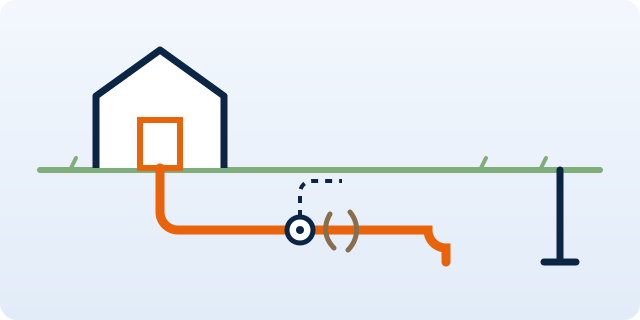
A water bill that jumps for no obvious reason is one of the more reliable signs of a hidden leak — a pipe inside a wall, a slab leak under the foundation, or a toilet flapper that's been silently running for weeks. Before scheduling a plumber or a costly leak-detection visit, you can usually confirm whether you actually have a leak — and roughly where it is — using nothing but your water meter and a few minutes. Here's how.
Find your water meter and the leak indicator
In most California cities, the meter sits in a small concrete or plastic box near the curb or property line, with a lid that lifts or pries open. Inside, you'll see a dial face with numbers (your usage reading, similar to an odometer) and, near or at the center, a small feature built specifically to catch leaks: a colored triangle, a star, or a tiny wheel that spins whenever any water is flowing through the meter — even a trickle too small to move the main numbers.
That indicator is the fastest read you'll get. If every faucet, hose, and appliance in the house is off and it's still spinning or flickering, water is moving through the meter with nowhere to go except a leak.
Step 1 — Shut everything off
Before you look at the meter, turn off every fixture and appliance that uses water: faucets, the icemaker line, the dishwasher and washing machine (don't just close the door — unplug or make sure a cycle isn't mid-run), and any irrigation or sprinkler timer that might kick on. If you have a pool with an auto-fill valve, that counts too — it's a common source of a leak indicator that never stops moving.
Step 2 — Watch the leak indicator
With everything off, go check the meter. If the triangle or dial is turning, you have water moving through the line right now. The speed matters: a slow, occasional flicker often points to something small like a slightly worn toilet flapper; a steadily spinning indicator suggests a more significant leak — a common one being a running toilet that never fully shut off, or an underground line losing real volume.
Step 3 — No visible movement? Do the two-reading test
Some leaks are too small for the indicator to move visibly, especially slow drips or a slab leak that's seeping rather than flowing. For those, read the actual numbers on the meter face and write them down. Leave everything off for at least 2 to 4 hours (overnight is even more reliable), then read the meter again. If the number changed at all while nothing in the house used water, that confirms a leak — the indicator dial isn't the only proof that counts.
Step 4 — Figure out which side of the meter it's on
This step matters because it determines who's on the hook for the repair. Locate your main shut-off valve — typically where the water line enters the house, often near the front hose bib or in a garage or utility closet — and close it fully. Then repeat the leak-indicator check at the meter:
- Indicator still moving with the house valve closed: the leak is between the meter and your shut-off valve, on the buried service line. Depending on your city and property type, that segment can be the utility's responsibility or the homeowner's — our guide to meter-to-house leak responsibility breaks down how that split usually works in California.
- Indicator stops moving once the house valve is closed: the leak is inside the house, somewhere between that valve and your fixtures — squarely the homeowner's repair, and worth pinning down with a plumber's leak detection equipment if you can't spot it visually (under sinks, around the water heater, in a crawl space).
What the confirmed leak is probably costing you
Once you know water is escaping continuously, the next question is how much that's adding to the bill. A leak too small to hear or see can still waste a surprising volume over a month — see our guide to what a leak actually costs for typical gallons-per-day figures by leak size, so you can weigh a quick fix against letting it ride until your next scheduled plumbing visit.
When to call in a professional
The meter test tells you that you have a leak and roughly which side it's on — it won't pinpoint a leak buried under a slab or hidden inside a wall cavity. If the leak is confirmed to be inside the house but you can't find the source by checking under fixtures and around the water heater, a plumber with acoustic or thermal leak-detection equipment can usually locate it without tearing open drywall or flooring first; see our leak detection cost and methods guide for what that typically involves and costs.
Get the leak located and fixed
A spinning leak indicator or a meter reading that keeps climbing with everything off is worth acting on — the longer a hidden leak runs, the more it costs in water and, in the case of a slab or wall leak, potential structural and mold damage. Plumber Comparator connects California homeowners with licensed plumbers experienced in leak detection in Sacramento, Anaheim, Bakersfield, and across the state. Request a free quote to get a confirmed leak found and repaired before it runs up the next bill.
On the scale of the problem nationally: a 2016 Water Research Foundation study summarized in the Journal AWWA by Peter Mayer, William DeOreo, and colleagues — an update to their earlier Residential End Uses of Water research — found that indoor leakage remains one of the largest and most persistent sources of wasted household water in North America, even as fixture efficiency has improved (study on Google Scholar). A five-minute meter check is a low-effort way to catch that waste on your own property before it adds up.
Need a plumber you can trust?
Tell us about the job — a licensed California plumber gets back to you with a real quote.
Get free quotes