Water Leak Between the Meter and Your House: Who Pays in California?
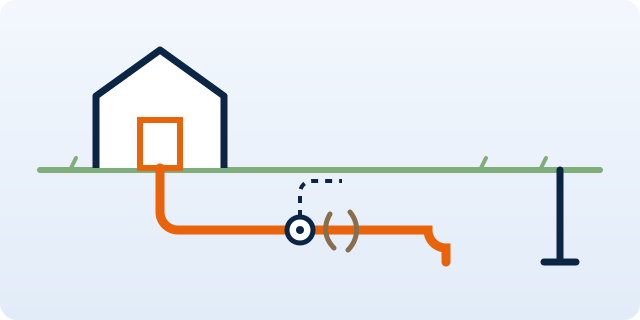
A soggy patch of lawn near the sidewalk, a water meter that spins even with every fixture in the house shut off, a water bill that suddenly doubled — the first question almost every homeowner asks isn't "how do I fix this," it's "wait, is this actually my problem?" The pipe between the street and the house crosses through public right-of-way, a water meter owned by a utility, and private property, and the rules for who pays to fix a leak in it are not the same as the rules for a leak under your kitchen sink. Here's how the line is actually drawn in California, how sewer lateral responsibility differs from water-line responsibility, and what to expect once you know which side of the property line the problem is on.
The general rule: the meter is the dividing line
In California, water utilities and municipal water departments are only authorized to maintain the system on their side of the meter — the main in the street, the service connection, and the meter itself. Everything from the meter's outlet onward, including the pipe running under your lawn or driveway to the house, is the homeowner's property and the homeowner's repair bill. Some utilities draw the line slightly differently, at a curb stop valve just inside the sidewalk rather than at the meter box, which shifts a short stretch of pipe to the customer's side — so the exact boundary is set by your specific water provider's tariff or service rules, not by a single statewide statute. That's the first thing to check, and most utilities publish it directly: Los Angeles Department of Water and Power, Cal Water, EBMUD, and most municipal providers all state plainly that the customer owns and maintains the service line from the meter to the structure.
Practically, that means a leak before the meter — in the main, in the utility's connection, or in the meter itself — gets reported to the utility and repaired at no cost to you. A leak after the meter, even if it's still ten feet from your front door under a public parkway strip, is on you to diagnose and fix, typically through a licensed plumber. See our main water line replacement cost guide for what that repair runs once you know it's your line, and our leak detection cost guide for how a plumber pinpoints the exact location before digging.
Sewer laterals follow a different — and less consistent — rule
Don't assume the same meter-based logic applies to your sewer line, because it doesn't. Sewer lateral responsibility is set city by city and sewer-district by sewer-district in the local municipal code, and California has no single uniform standard. The most common arrangement, used by cities including Oakland, San Jose, and Sacramento, splits the lateral at the property line: the homeowner maintains the pipe from the house to the property line, and the sewer district maintains everything from the property line to the main. Los Angeles works differently — a long-standing City Attorney opinion holds LA property owners responsible for the full lateral, including the segment running under the public sidewalk and street, all the way to the connection at the main. Other cities have shifted the entire lateral onto the homeowner in recent years to reduce their own maintenance liability. There is genuinely no substitute here for checking your specific city's or sanitation district's ordinance before assuming who pays — see our sewer camera inspection guide for how a plumber documents exactly where a lateral problem sits before that call gets made, and our guide on service line insurance coverage for a coverage option that sidesteps the ownership question for a modest monthly add-on.
How to tell which side of the line your leak is on
- Check the meter with everything off. Shut off every fixture and appliance, then watch the small triangular or star-shaped leak indicator on the meter face. If it's still spinning, water is flowing somewhere between the meter and the house (or before the meter, on the utility's side) — see our full walkthrough in the high water bill guide.
- Locate the meter box and the curb stop. If visible wetness, a sinkhole, or pooling water is between the street main and your meter box, that's presumptively the utility's territory — call them before you call a plumber.
- If the wet spot is between the meter and your house — even in the parkway strip technically owned by the city — that stretch belongs to you under nearly every California utility's rules, because ownership of the pipe follows the meter boundary, not the property line.
- When in doubt, call the utility first. Most California water providers will send someone to check the meter and confirm which side a leak is on before you pay a plumber to dig — it costs nothing to ask, and utilities have a strong incentive to correctly identify main-side leaks since unbilled water lost before the meter is their loss, not yours.
Why the utility side of this matters more than it looks
This isn't just a billing technicality. A 2019 peer-reviewed analysis by Deborah Vacs Renwick and colleagues at the EPA, published in the Journal AWWA, examined the public-health risk posed by aging and deteriorating water distribution infrastructure nationwide, and found that pipe breaks and pressure loss events create real pathways for contamination to enter drinking water systems, not just service disruptions (study on Google Scholar). That's part of why utilities take main-side leaks seriously and respond quickly once notified — a slow leak at the main isn't only wasted water, it's a pressure and contamination risk for the whole street, which is a good reason to report a suspected main-side leak promptly rather than assume someone else already has.
What repair costs once it's confirmed to be yours
If the leak is on your side of the meter, cost depends heavily on depth, pipe material, and what's above the pipe — a leak under a lawn is a different job than one under a driveway or a mature tree's root system. Expect a straightforward open-trench repair on a short accessible run to land in the $500–$2,500 range for a localized fix, while a full service line replacement (common on homes with old galvanized or copper lines showing multiple failure points) runs closer to the figures in our main water line replacement cost guide, often $1,500–$6,000+ depending on length and whether trenchless boring is an option instead of open trenching. Get a firm number for your specific situation rather than budgeting off a range — request a free quote from a licensed plumber serving Fresno, Oakland, or San Jose, and confirm they'll coordinate any required street or parkway permit if the repair crosses public right-of-way.
The practical move
Before assuming a leak near the curb is "the city's problem" or "definitely mine," do two five-minute checks: read the meter with everything off, and look up your water provider's published service-line policy (most post it directly on their website) plus your city's sewer lateral ordinance if it's a sewer issue rather than a water leak. That alone resolves most of the uncertainty. For anything on your side of the line, a licensed plumber can confirm the exact leak location with proper equipment before any digging starts, which avoids paying to open the wrong section of yard twice.
Need a plumber you can trust?
Tell us about the job — a licensed California plumber gets back to you with a real quote.
Get free quotes