Can Your Existing Water Line and Sewer Lateral Handle a New Bathroom or ADU in California?
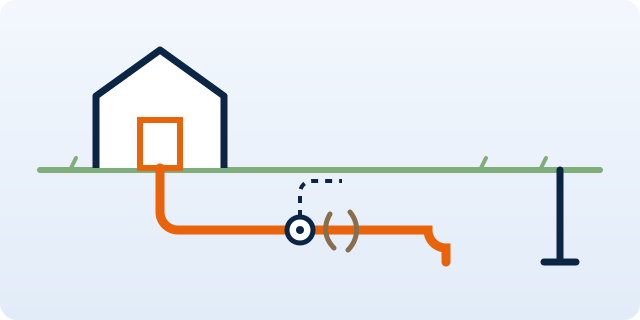
Bathroom additions and ADUs in California get designed first and plumbed second: the plan is drawn, the fixtures are picked, and only later does anyone ask whether the pipes already serving the house can carry the load. That order is why so many of these projects end with a five-figure change order for a trench nobody budgeted — and the answer is cheap to get. A plumber with a pressure gauge and a camera can usually tell you inside an hour.
Two different capacity questions, and only one is about pipe
"Capacity" means two separate things in a California permit file. The first is administrative: the right to consume more of the public system's treatment and delivery capacity, charged as a one-time capacity or connection fee by your wastewater agency and water utility. It varies wildly by district, and our guide to bathroom addition permits and sewer capacity fees covers it in full. The second is physical: whether the pipe in the ground can actually move the water in and the waste out. No fee resolves that one, and it is what this page is about.
The water side: three things decide it
Supply capacity is set by whichever of three components is tightest, and they are rarely the same size.
- The meter. Most California single-family homes run a 5/8-inch or 3/4-inch meter, with 1-inch on larger or newer houses. It is a hard ceiling on flow, and it belongs to the utility.
- The service line from the meter to the house. The usual bottleneck. A 1/2-inch line, or original galvanized of any diameter, chokes a project long before the meter does — and unlike the meter, this pipe is yours.
- Static pressure at the street. Everything downstream works from whatever the main delivers to your address. A lot near the top of a pressure zone starts with less to give away.
Fixture units, and why demand does not add up
Code does not size a supply line by adding up the flow rate of every fixture. Each gets a water supply fixture unit value — a weighting for how much it uses and how often — and the total is converted, through a demand curve, into a probable peak flow. Fixtures are counted, not summed, because a three-bathroom house never runs three showers, a dishwasher and a hose bib at once.
That matters to your budget, because the curve in general use is generous. It descends from Roy Hunter's 1940 work, and research by Toritseju Omaghomi and Steven Buchberger at the University of Cincinnati — Estimating Water Demands in Buildings, Procedia Engineering 2014, later the basis for IAPMO's Water Demand Calculator — found the classic method substantially overestimates peak demand in small buildings with modern low-flow fixtures (study on Google Scholar). So if a paper calculation says your service line is too small, it is probably conservative. Measure the real thing before paying to replace anything.
How a plumber checks it before anyone draws
- Read the meter size off the meter. It is stamped on the register lid or the body. Two minutes, no appointment.
- Take a static pressure reading at a hose bib with a threaded gauge, nothing else running — our guide to testing your home's water pressure and reading the PSI covers the procedure and a normal number.
- Take a second reading under flow. The step homeowners skip, and the one that diagnoses the service line. Leave the gauge on, open two or three fixtures, watch the needle. Holding steady means the street and the service line both have headroom; collapsing means the restriction is in your pipe, not in the utility's pressure.
That drop-under-flow number is the most useful thing you can hand a designer, and the gauge costs about $10 to $15.
Two very different fixes
If the bottleneck is the private service line, the fix is trenching and replacing it at a proper diameter — the same work as any main water line replacement, typically $3,000 to $12,000 for a 30-to-80-foot run, entirely between you and a licensed plumber. If it is the meter, the job runs through the water utility instead, on their fee schedule and their backlog — where the money and the waiting live. Our water meter upsizing guide covers the possible scopes and the water service tap fee guide how capacity fees scale with meter size.
Galvanized and tired copper: fine for one bathroom, not for two
Corrosion does not only cause leaks, it narrows the pipe. Galvanized steel rusts and tuberculates from the inside, so a nominal 3/4-inch line can be flowing like something far smaller decades later. It may have served one bathroom for forty years and still fail the moment a second one asks for water at the same time: the effective bore was already marginal and nobody noticed. Older copper with heavy scale behaves the same way. Our guide to identifying galvanized and polybutylene pipe covers how to spot it; if the interior piping is the same vintage, an addition is the moment to price a whole-house repipe alongside it rather than opening walls twice.
The sewer side: diameter is rarely the problem
Homeowners worry most about the drain, and it usually has the most room to spare. Drainage is sized by drainage fixture unit — the same counting logic — and a standard 4-inch house lateral carries far more fixture units than any single-family home with a handful of bathrooms will ever produce. Adding one bathroom to a healthy 4-inch lateral is, hydraulically, a non-event. (The narrow exception, a 3-inch building sewer already at its toilet limit, is in the permit guide above.)
What actually limits an existing lateral is its slope, its condition and its depth. Code minimums are modest — commonly a quarter inch of fall per foot on smaller drains, an eighth on 4-inch and larger — and a lateral that has settled below that is already running at reduced capacity. Add a belly holding standing water, root intrusion at the joints, or a partial collapse, and it will fail under the new load even though its diameter reads fine on paper. Research by Marlow and colleagues in the Journal of Infrastructure Systems (2011) found sewer blockages attributable to a cluster of interacting factors — pipe age, material, roots, network characteristics — rather than any single measurable like size (study on Google Scholar).
So the honest first step is a camera, not a calculation. A sewer camera inspection runs roughly $150 to $500 and settles in twenty minutes what no fixture-unit arithmetic can; our guide to reading a sewer camera inspection report explains the defect vocabulary. If it finds a failing lateral, who pays for the section under the street depends on your city — see sewer lateral responsibility in California.
Depth and gravity: the constraint that kills projects
This is the one that changes floor plans. A gravity drain works only if the new fixtures sit above the lateral's invert — the inside bottom of the pipe — with enough fall left to reach it. A basement bathroom, a below-grade garage conversion, or an ADU on the low end of a sloping lot can land below that line, and no diameter fixes it. The remedy is mechanical: a sealed basin and a sewage ejector pump lifting waste up to the lateral, or a macerating unit behind a single toilet. Our comparison of sump pumps versus sewage ejector pumps explains why the two are not interchangeable, and the upflush macerating toilet guide covers the lighter-duty option. A full ejector installation in a conversion commonly runs $2,000 to $5,500. Find out which side of the invert you are on before the slab is designed.
Venting gets checked at the same time
New fixtures need vent capacity as much as drain capacity, and a stack sized for two bathrooms may not legally serve three. It is quick to assess while the plumber is already looking at the drainage, and it occasionally moves the room — the symptoms of getting it wrong are in our guide to gurgling drains and blocked vent stacks.
What to hand your plumber
- Meter size, read off the meter itself.
- Static pressure at a hose bib, plus the reading under flow with two or three fixtures open.
- Age, material and approximate length of the service line from meter to house.
- A camera run of the lateral, with the footage-stamped video, not a verbal summary.
- The fixture count you are adding, and whether any of it sits below the existing lateral.
All of that costs a few hundred dollars at most, against a project where the plumbing alone runs from the low five figures for a bathroom addition to well past $40,000 on a detached ADU. The detailed pricing lives on those pages; this one is about whether the pipes you already own can carry the plan.
Get the capacity checked before the design is locked
Homeowners in Pasadena, Long Beach and San Jose use Plumber Comparator to get a licensed plumber out to measure the water service and camera the lateral before an addition or ADU goes to design. Describe the job — the fixtures you are adding, the age of the house, and whether the new space sits above or below the existing drain line — and request a free quote.
Need a plumber you can trust?
Tell us about the job — a licensed California plumber gets back to you with a real quote.
Get free quotes