How to Read a Sewer Camera Inspection Report: What the Video Actually Shows
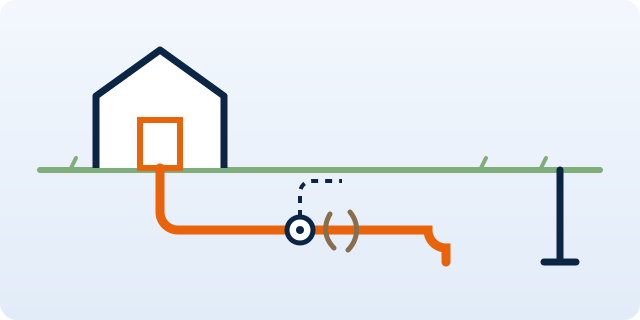
A sewer camera inspection is one of the few plumbing services where the homeowner is handed evidence rather than an opinion — and one of the few where almost nobody knows how to read the evidence. You watch a wobbling image of a wet pipe on a small screen for four minutes, hear "offset joint at forty-two feet," and then get a quote. This guide is about that four minutes: what the defects actually look like, what the written report has to contain to be worth anything, and how to tell a genuine diagnosis from a line that is being talked into a replacement.
If you are here for pricing, most California camera inspections land in the $150–$500 range — our sewer camera inspection cost page and the California camera inspection pricing guide break that down. The rest of this page is about what you get for the money.
What the camera is and how it gets into your line
A sewer camera is a waterproof lens and LED ring on the end of a stiff fiberglass push rod, coiled on a reel. The plumber feeds the rod down the line by hand; the reel has a footage counter that ticks off distance as the rod pays out, and that counter is the single most important number in the whole inspection. Most main-line heads are an inch and a half to two inches across, which is why they run happily down a 4-inch sewer lateral but cannot navigate a 2-inch kitchen branch.
Access decides everything. A proper exterior sewer cleanout — a capped riser in the yard or against the foundation — is the ideal entry: the rod goes in above the trap and runs downstream toward the street. If the house has no cleanout, which is common in California homes built before the 1970s, the options narrow to pulling a toilet off its flange or going through a roof vent. Pulling a toilet adds labor and a wax ring to the bill and starts the run further inside the house. A roof vent entry is worse: the rod has to negotiate hard bends, and the footage counter no longer lines up with anything measurable from the street. If a company says they cannot inspect your line at all, this is usually why — and adding a cleanout is often the cheaper first move rather than an upsell.
The defect vocabulary, in plain English
Here is what the words mean when they are called out over the reel:
- Root intrusion. Fine hair-like roots, or a dense mat, coming through a joint or crack. Roots do not drill through sound pipe; they find an existing opening and exploit it, so root intrusion is always also evidence of a joint or crack problem. Our guide on roots in sewer lines covers what to do about the tree as well as the pipe.
- Offset joint. Two pipe sections that no longer line up where they meet — you see a crescent of pipe wall stepping into the frame. Small offsets catch paper and grease; large ones catch everything.
- Separated joint. The sections have pulled apart entirely and you can see soil, gravel, or a dark void in the gap. That is a soil-entry point, and it is how sinkholes start.
- Crack vs. fracture vs. broken vs. collapsed. Not synonyms, and the difference drives the whole repair decision. A crack is a break line that is not visibly open. A fracture is the same break, now visibly open. Broken means pieces of the wall have moved out of position. Collapsed means the pipe no longer holds its shape and the flow path is gone.
- Belly or sag. A section that has settled below grade so water stands in it. You will not see damage — you will see the lens submerge, the picture go brown, and the counter keep running. A belly is a grade problem, not a wall problem; see our guide on bellied sewer lines and what repair actually costs.
- Scale, mineral buildup, and grease. Roughness, ledges, or a waxy coating narrowing the bore. Maintenance findings, not structural ones — usually a case for cleaning, not replacement.
- Cast-iron channeling. In old cast iron the bottom of the pipe corrodes away first, leaving a trough — sometimes right through the wall — while the top looks fine. On screen it reads as a dark rusty gutter along the bottom of the bore. Our cast-iron drain pipe replacement guide covers what that means for a whole-house system.
- Orangeburg deformation. Bituminized fiber pipe, used in some postwar California tracts, does not crack so much as go soft and oval, sometimes blistering inward. If the picture shows an egg-shaped bore in a house of the right vintage, read our Orangeburg pipe replacement guide — this material is generally not a candidate for spot repair.
What NASSCO grades mean when a contractor quotes one
If a contractor says your line is "a grade 4," they are referencing NASSCO's Pipeline Assessment Certification Program (PACP), the North American standard for coding sewer CCTV inspections. Every observed defect gets a condition grade from 1 (minor) to 5 (most significant). The crucial part, and the part that protects you, is that the grade is not the operator's opinion — it is looked up from the defect code and its measured values in the PACP manual. NASSCO's own technical guidance spells out the structural progression: a longitudinal crack that is not visibly open is a grade 2; once that crack is visibly open it becomes a fracture and a grade 3; if pipe pieces are displaced it is coded broken, a grade 4; and if soil or a void is visible behind the broken wall, it is a grade 5 (NASSCO Tech Tips, "PACP Condition Grades and Their Proper Application").
Two things follow. First, a grade should be traceable to a specific coded observation at a specific footage — if someone quotes a grade but cannot say which code produced it or where, the number is decoration. Second, NASSCO itself is explicit that the grade is not a verdict: condition grade alone, it warns, is inadequate for deciding whether a segment should be replaced or rehabilitated, and cannot substitute for an engineer's judgment. Anyone using "it's a five" as the entire justification for a five-figure quote is overreaching the standard they are invoking. Note too that PACP was built for municipal mainlines; NASSCO publishes a separate lateral program for the private service line under your yard, so a mainline grade applied to a house lateral is at best an analogy.
What a complete report contains
A camera run that produces nothing but a verbal summary and a quote is not an inspection. Ask for, and expect:
- A copy of the video you keep — a file or a link, not a screen you watched once. This is your evidence if you sell the house, file an insurance claim, or get a second bid.
- A visible, running footage counter in the video itself. Without distance, a defect cannot be located, priced, or dug up.
- A surface locate with depth. The camera head carries a sonde — a small transmitter — that a technician tracks from above ground with a receiver, marking the spot on your lawn or driveway and reading off the depth. "There's a break somewhere around fifty feet" is not a locate. A paint mark on the ground plus a depth in feet is.
- Still images of each significant finding, captioned with its footage.
- Pipe material and diameter — clay, cast iron, ABS, PVC, Orangeburg, and the nominal size. Material changes the repair options completely.
- The access point used and the direction of travel, plus where the run stopped and why (obstruction, end of rod, city main).
Red flags worth walking away from
- You never see the video. Not during, not afterward. There is no legitimate reason for this.
- No footage counter on screen. A defect with no distance attached cannot be verified by anyone else — which is precisely the effect.
- A "collapse" claim with no locate. A genuine collapse is easy to mark on the ground with a sonde. If nobody will paint the spot, be skeptical.
- The camera went down a line that was never cleaned. This is the big one. Grease, sludge, and paper on the pipe wall look a lot like structural damage on a wet lens, and standing debris can be sold as a belly. A defensible inspection of a problem line usually follows a hydro jetting or cabling pass, so the camera is looking at pipe rather than at what is stuck to it.
- Same-visit pressure. A pipe that has been failing for fifteen years does not become an emergency because a salesperson is standing in your kitchen. Sewage backing up into the house is an emergency; a fracture at sixty feet is a planning problem.
Why a second opinion is not paranoia
There is real research on this. A 2013 study by Dirksen, Clemens, Korving and colleagues in Structure and Infrastructure Engineering tested the reproducibility of visual sewer inspection across three human steps — spotting a defect, coding it, and interpreting the report — and found the process considerably less consistent than the confident-looking data it produces suggests ("The consistency of visual sewer inspection data" on Google Scholar). Fugledalen, Rokstad and Tscheikner-Gratl went further in a Norwegian case study: they re-classified pipe condition from the same video footage, turned the disagreements into a measured uncertainty distribution, and propagated it through a deterioration model — showing the variability between people watching identical video is large enough to change what the model recommends doing about the pipe ("On the influence of input data uncertainty on sewer deterioration models" on Google Scholar).
That is trained inspectors, working to a formal coding standard, disagreeing over the same footage. A second read of your own line — ideally by a company that does not sell trenchless replacement — is a reasonable response, not an insult to the first plumber.
Turning the report into a repair decision
Findings map to scope roughly like this. Scale, grease, and light roots with sound joints are a cleaning and monitoring problem. One or two localized structural defects in an otherwise sound line point toward a spot repair — our guide comparing spot repair against full sewer replacement walks through where that line falls. Defects distributed along the whole run, with the pipe still round and continuous, are the classic case for cured-in-place lining. Collapse, severe bellies, deformed Orangeburg, or a line so far out of alignment that a liner cannot be pulled through it are what actually justify full replacement. If your quote skips two steps in that ladder, the report should explain why — in writing, at a footage you can point to.
Homeowners in San Diego, Fresno, and Sacramento use Plumber Comparator to get a second camera run and an independent read on a report they were not sure about. Describe the job — the age of the house, whether you have a cleanout, and what the first inspection claimed to find — and request a free quote from licensed local plumbers.
Need a plumber you can trust?
Tell us about the job — a licensed California plumber gets back to you with a real quote.
Get free quotes