Sewer Line Spot Repair vs Full Replacement in California: Costs and How to Decide
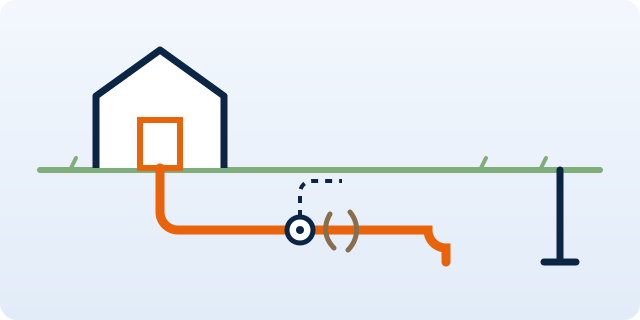
The camera inspection is done, the news is bad, and now you're holding two wildly different quotes: one plumber proposes a $4,000 repair of "the bad section," another insists the whole line needs replacing for $18,000. Neither is necessarily wrong — sewer laterals genuinely fail both ways, in one spot or all over. Knowing which situation your pipe is in is worth thousands of dollars, and the evidence is sitting in the camera footage you already paid for.
What a spot repair is
A spot repair (or sectional repair) fixes a localized defect — one offset joint, one root-invaded hub, one crushed section under a tree root — while leaving the rest of the line in service. It comes in two flavors:
- Excavated spot repair: $1,500–$5,000. Dig down to the defect, cut out the bad section, install new pipe with proper couplings. Straightforward in a front lawn at moderate depth; the price climbs with depth, hardscape above, and utility congestion — a repair under a driveway or mature tree can double.
- Trenchless sectional liner (patch): $1,000–$4,000. A resin-saturated sleeve is inverted or pulled into place over the defect and cured, creating a structural pipe-within-a-pipe over just those few feet, no digging. This is small-scale CIPP — cured-in-place pipe — the same technology as full-length lining. Its durability isn't marketing: a retrospective field evaluation by Allouche and colleagues, "A pilot study for retrospective evaluation of cured-in-place pipe (CIPP) rehabilitation of municipal gravity sewers" (Tunnelling and Underground Space Technology, 2014), exhumed and tested CIPP liners after up to 25 years in service and found them largely retaining their structural properties (study on Google Scholar).
When spot repair is the right call
- The camera shows one clearly localized defect — a single offset, break, or root entry — in a line that otherwise shows clean joints and good pipe wall.
- The pipe material has life left: ABS or PVC with one damaged spot, or clay with a single failed joint, are good candidates. Our root intrusion guide covers why clay joints are the classic single-point failure.
- The defect is deep or under expensive hardscape, where a trenchless patch avoids a $3,000 concrete-cutting bill.
When replacement wins
- Systemic material failure: Orangeburg (bituminous fiber) pipe that's deforming, cast iron scaled and channeled bottom-out, or clay with roots at every joint. Patching one joint of ten identical ones buys you a year, not a solution.
- Multiple defects spread along the line — two spot repairs approach the cost of lining the whole run; three exceed it.
- Grade problems: a bellied (sagging) line can't be fixed by lining — liners follow the host pipe's shape, belly included. Re-laying the affected run at proper slope is the only real fix.
Full replacement or whole-line rehabilitation in California runs $4,000–$25,000 depending on length, depth, and method — open trench versus pipe bursting versus full-length CIPP are compared in our trenchless replacement guide, and the broader ranges are on the sewer line repair cost page.
How to protect yourself in the quote process
- Get the footage. You paid for the camera inspection; the video file with distance counter is yours. A contractor who won't share it is selling something other than plumbing — a pattern from our red flags guide.
- Ask each bidder to justify their scope against the footage — "replace it all" should come with timestamps showing distributed defects, and "just patch it" should come with clean footage either side of the defect.
- Check warranty terms: spot repairs typically carry 1–5 years; liners and new pipe often 10–50. A cheap patch with no warranty on a 70-year-old clay line prices in its own return visit.
- Confirm permits: sewer repairs are permitted work, and some Bay Area cities layer on the lateral compliance certificates described in our lateral inspection guide.
If you have camera footage and conflicting quotes, a third opinion is cheap relative to the spread. Request a free quote and compare — sewer contractors in Chula Vista, Citrus Heights, and across California bid these jobs daily, and honest ones will tell you when the cheaper fix is the right one.
Need a plumber you can trust?
Tell us about the job — a licensed California plumber gets back to you with a real quote.
Get free quotes