Orangeburg Sewer Pipe: How to Tell If You Have It and What Replacement Costs in California
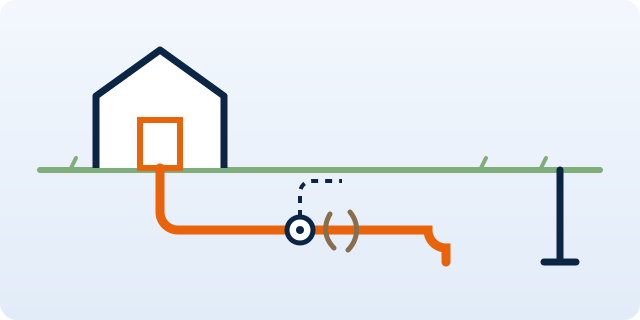
Of all the pipe materials a sewer camera can find under a California home, Orangeburg is the one that ends the conversation fastest. Clay pipe with root intrusion can be spot-repaired; cast iron with scale can be descaled and lined. Orangeburg — bituminous fiber pipe, essentially layers of wood pulp impregnated with coal tar — doesn't crack like the others. It softens, ovalizes, and collapses, and once a camera confirms it, the question is not whether to replace but how soon and by which method.
What it is and which homes have it
Orangeburg pipe (named for the New York town where the largest manufacturer operated) was used for sewer laterals roughly from the 1940s through the early 1970s, when iron was diverted to wartime production and later because it was cheap and light. Its realistic service life is about 50 years — often less under driveways or in expansive soils — which means essentially every Orangeburg lateral still in the ground is past its design life today. In California, the candidates are homes built or connected to sewers from the mid-1940s to about 1972: large swaths of postwar tract housing across Los Angeles County, the inland East Bay, San Diego's midcentury neighborhoods, and Central Valley cities that boomed in the 1950s and 60s. Homes on Sacramento-area and Fresno-area postwar streets are classic finds.
How it fails: deformation, not cracks
Because the material is laminated fiber rather than rigid ceramic or metal, Orangeburg fails by losing shape: the pipe absorbs moisture, delaminates, and gradually flattens from round to oval under soil load ("egg-shaped" on camera), while the interior blisters. Roots enter easily through the softened wall and accelerate everything. The failure sequence engineers describe for rigid sewer pipes — defect, deformation, loss of soil support, collapse — is well documented; the widely cited study by Davies, Clarke, Whiter and Cunningham, published in Urban Water in 2001, catalogs how structural deterioration and surrounding soil conditions interact to take a deteriorating sewer from first defect to collapse (study on Google Scholar). Orangeburg simply runs that sequence faster and with less warning than clay or iron.
Symptoms are the usual lateral-failure set — repeated backups, gurgling, soggy or sunken lawn stripes, sewer odor — covered in our guide to telling a clog from a main line problem. The diagnosis, though, only comes one way: a camera inspection ($150–$450), where Orangeburg's oval profile and blistered walls are unmistakable to an experienced operator.
Can it be lined instead of dug up?
Sometimes — and it's the first thing to ask. Cured-in-place pipe (CIPP) lining needs a host pipe that still holds enough shape to line: an Orangeburg lateral that's begun ovalizing but hasn't collapsed can sometimes be rehabilitated after reshaping, while a flattened or blistered section cannot. Pipe bursting — pulling a new HDPE pipe through while fracturing the old one — handles worse deformation than lining and is often the sweet spot for Orangeburg. Both trenchless options and their prices are compared in our trenchless sewer replacement guide.
Replacement cost
- Trenchless (pipe bursting or lining where feasible): roughly $80–$250 per foot, typically $6,000–$20,000 for a full lateral depending on length, depth, and access pits.
- Open-trench replacement: $50–$150 per foot plus surface restoration — cheap in a lawn, expensive through a driveway or mature landscaping.
- Partial repairs rarely make sense with Orangeburg: unlike clay, where one root-damaged joint can be fixed, the whole Orangeburg run is the same age and the same failing material — the economics of spot repair vs full replacement tilt hard toward full replacement here.
- City permits, cleanout additions (see cleanout costs), and point-of-sale lateral rules can all ride along on the project.
If the camera just found it
You don't have to replace it this week if it's flowing — but you should plan as if the clock is running, because it is: every year adds deformation, and a collapse converts a planned trenchless job into an emergency dig at emergency prices. Get the camera footage on a USB drive, get two or three bids quoting both bursting and open trench, verify each contractor via our CSLB license guide, and request free quotes to compare against. Buying the house rather than owning it yet? Orangeburg on the pre-purchase camera is a genuine negotiation item — our pre-purchase plumbing inspection guide covers how to use it.
Need a plumber you can trust?
Tell us about the job — a licensed California plumber gets back to you with a real quote.
Get free quotes