Adding a Bathroom in California: Permits & Sewer Capacity Fees
Ask three plumbers to quote a new bathroom and you'll get three numbers for the same thing: pipe, fixtures, labor. None of them includes the paperwork side — permits, plan check, and in many California jurisdictions a sewer capacity charge that surfaces only when your contractor walks the plans into the counter. Nobody is hiding them; they're billed by the city, county or special district rather than the plumber, so they sit outside the estimate. This guide covers only that administrative layer. For the construction budget, see our cost to add a bathroom guide the cheaper powder room addition variant, and — if the new bathroom is going upstairs — our guide to second-floor bathroom plumbing costs.
Adding a fixture is not replacing a fixture
This distinction drives everything else. Swapping a toilet for another in the same spot is maintenance — the drain, vent and supply line already carry that load, so most California jurisdictions don't require a permit. Adding a toilet where none existed changes the sanitary drainage system, and the building department now has to confirm the new drain is correctly sized, sloped and vented, that the existing building drain and sewer can carry the added load, and that the water supply can still serve every fixture at once.
That review is why the fee structure differs too: added fixtures are charged per fixture and — in some districts — charged again by the wastewater agency for the capacity you consume. Our plumbing permits guide covers which jobs need a permit generally; a bathroom addition is on the permit-required side of that line everywhere in the state.
Which permits you actually need
- Plumbing permit — always, for the new drain, waste, vent and supply work. Usually priced per fixture added, plus a base fee.
- Building permit — required once you touch walls, framing, floor structure or the envelope. Cutting joists to run a 3-inch drain qualifies.
- Electrical and mechanical permits — GFCI outlets, lighting, and an exhaust fan ducted outside. Some jurisdictions bundle these into a combination permit; others bill each trade.
- Plan check — triggered by structural work or whenever the department wants stamped drawings. It's a separate fee from the permit, usually a percentage of the permit fee or of project valuation, and it sets your calendar more than anything else.
Over-the-counter issuance is realistic for a bathroom carved out of a closet with no structural change. Once plan check is involved, first review commonly runs a few weeks in smaller jurisdictions and considerably longer in the largest coastal cities; most departments sell expedited review at a premium.
Drainage fixture units: the number that can enlarge your sewer line
The California Plumbing Code sizes drains by drainage fixture unit (DFU), a load value per fixture. A standard 1.6-gallon private water closet counts as 3 DFU, a lavatory as 1, and a bathtub or shower as 2 each — so a full new bathroom adds roughly 6 to 8 DFU to what your house already carries.
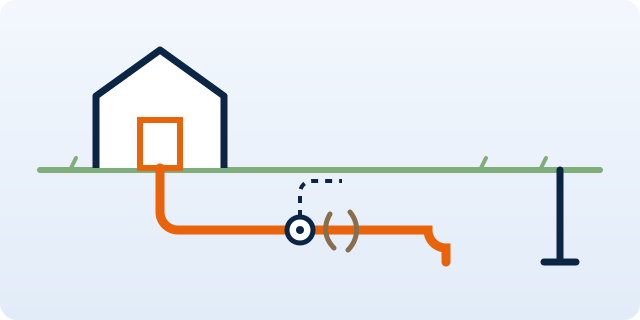
Two thresholds matter. The code's drainage sizing table caps the load each pipe diameter may carry, and it separately limits a 3-inch line to two water closets. A mid-century house plumbed with a 3-inch building sewer and two toilets is at that limit already, so adding a third can force upsizing to 4 inches — trenching from the house to the property line, a five-figure line item on its own. Have your plumber verify the existing sewer diameter and toilet count before the floor plan is locked; a sewer camera inspection plus a look at the cleanout answers it in an hour. If the line does need upsizing, responsibility for the segment under the street varies by city — our sewer lateral responsibility guide explains who pays.
Sewer capacity charges and connection fees
This is the fee homeowners never see coming. Wastewater agencies — a city department, a county sanitation district or a standalone special district — levy a one-time capacity charge (also called a connection fee) to recover the treatment capacity your property consumes. Government Code Section 66013 requires these to reflect the reasonable cost of serving the added demand, which is why they're calculated so differently from place to place. Two methods dominate:
- Equivalent dwelling units (EDU). One EDU represents the wastewater of a typical single-family home. Under this model a bathroom added to an existing house often triggers nothing, because you haven't added a dwelling unit — the property still counts as one EDU. Many agencies say so explicitly.
- Fixture-unit counting. Other agencies bill by drainage fixture unit, sometimes with a block of units included in base residential service and a per-unit charge above it. Add a bathroom to a house already near that threshold and you pay the overage.
Because the method varies, so does the bill: depending on the agency, adding a bathroom can cost nothing, a few hundred dollars, or several thousand. Anyone quoting a single statewide figure is guessing. The only reliable answer is a call to the agency that treats your wastewater — often neither your building department nor whoever bills your water.
There can be a water-side charge too. Many utilities set the water capacity charge by meter size, and meter size derives from your total water supply fixture units. Adding a third or fourth bathroom to a house on a small residential meter can push calculated demand past that meter's rating, meaning an upgrade plus the capacity-charge difference. Departments have a fixture count worksheet for exactly this.
Are these fees fair, and do they actually land on you?
They're a small version of the development impact fees economists have studied for decades. Research by Shishir Mathur, Paul Waddell and Hilda Blanco in Urban Studies (2004), analyzing single-family transactions across 38 cities in King County, found impact fees were passed into new home prices at well above face value — roughly 166 percent of the fee on average (study on Google Scholar). A broader review by Vicki Been in HUD's Cityscape (2005) was more cautious, concluding that who ultimately bears such a fee depends heavily on local market conditions (study on Google Scholar). The homeowner takeaway: budget these as a separate line, not as something rolled into the quote.
One more if the bathroom adds square footage: school districts may levy Level 1 developer fees on residential additions, but Education Code Section 17620 allows it only when the increase in assessable space exceeds 500 square feet. Carve the bathroom out of existing space and it doesn't apply.
Inspections: rough-in, then final
Permitted bathroom work is inspected at least twice. The rough-in inspection happens before anything is covered — DWV and supply piping exposed, typically with the drainage system under a water or air test. Don't let a drywaller near the room before it passes. The final inspection follows once fixtures are set, covering clearances, the exhaust fan, GFCI protection and anti-scald valve compliance. Schedule both a few days ahead, and expect a correction item on a first inspection — that's normal.
If you're on a septic system, start with the county health department
County health departments size septic systems by bedroom count and fixture load, so adding a bathroom — especially alongside a new bedroom — forces a review of whether the existing tank and leach field have capacity. If they don't, expect leach field expansion, a larger tank or a full redesign, plus a new septic permit and often a fresh soil evaluation. That review runs through the county's local agency management program on its own timeline and can block a project the building department would otherwise approve. See our guides on the percolation test and leach field work. Call the health department before you pay for architectural drawings, not after.
The resale problem with skipping all this
California's Real Estate Transfer Disclosure Statement, required under Civil Code Section 1102.6, asks the seller directly about room additions, structural modifications or alterations made without the necessary permits. Answering dishonestly is a disclosure problem; answering honestly invites a price reduction or a demand that you legalize before close. Legalizing after the fact is the expensive path — most jurisdictions add an investigation fee on top of the normal permit, commonly double the standard fees and higher in some cities, and retroactive permits are judged against current code, not the code in force when the work was done. Add in opening finished walls so an inspector can see the rough-in, and the savings evaporate several times over.
Calls to make before you sign a plumber's quote
- Building department: which permits apply, whether the scope triggers plan check, the current fee schedule, and realistic review time.
- Wastewater agency (confirm first which one serves you): is there a capacity or connection charge for adding fixtures to an existing single-family home, and is it assessed by EDU or by fixture unit?
- Water utility: will the added fixture units require a larger meter, and what do the upgrade and any capacity charge cost?
- County health department, if you're on septic: does the existing system have documented capacity for the added load, and what does re-permitting involve?
- Your plumber: existing building sewer diameter, current toilet count, and total DFU after the addition — in writing, before design is locked.
- Your HOA, and the city again if the bathroom sits below the sewer line and needs an ejector pump, which carries its own approvals.
Six calls, most under ten minutes, and you'll know the real number instead of the plumbing-only number. Plumber Comparator connects California homeowners with licensed plumbers who handle permitted fixture additions in Los Angeles, San Jose, San Diego, Sacramento and across the state. Request a free quote and mention how many bathrooms the house has today — it's the detail that decides whether your sewer line, and your budget, can absorb another one.
Need a plumber you can trust?
Tell us about the job — a licensed California plumber gets back to you with a real quote.
Get free quotes