Is Your Downspout Connected to the Sewer Line? Why It's Illegal in California and What Disconnecting Costs
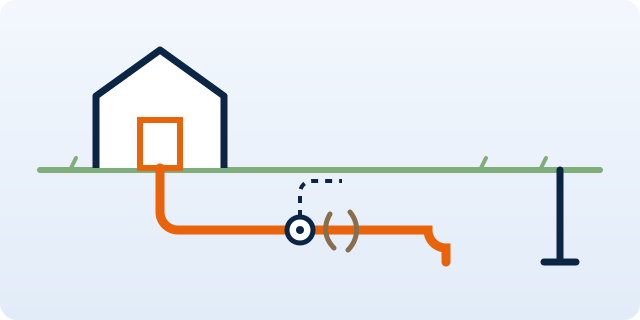
If a heavy winter storm makes your toilets gurgle, your floor drain bubble, or a sewer smell suddenly appear in the yard — and none of that happens in dry weather — the cause is often something built into the house decades ago and never questioned since: a downspout, area drain, or sump pump piped straight into the sanitary sewer lateral instead of a storm drain or the yard. It was common practice in older construction. It is not legal today, and it is worth checking whether your house still has it.
Why this was ever done — and why it's a problem now
Sanitary sewer pipes carry wastewater from toilets, sinks and drains to a treatment plant. Storm drains carry rain runoff to a creek, bay, or the ocean, untreated. Decades ago, in many California neighborhoods, it was simpler for a builder to tie a roof downspout or a yard's area drain into whichever pipe was closest — often the sewer lateral already running out to the street. Nobody thought much of it at the time.
The problem shows up during storms. Engineers call this "inflow" — stormwater entering a system that was only ever sized for household wastewater. A single downspout dumping roof runoff into the sewer during a heavy storm can add thousands of gallons to that pipe in a matter of hours. Multiply that across a street or a neighborhood with the same old habit, and treatment plants and pump stations that handle everyday flow without issue can be overwhelmed, backing sewage up into the lowest fixtures in nearby homes — often a garage floor drain or a ground-floor toilet — or overflowing untreated into a creek or storm channel. That is a sanitary sewer overflow (SSO), and it is exactly the kind of event California's local sewer authorities are required to report and work to prevent.
This isn't a hypothetical inconvenience. A 2017 study by Jagai, DeFlorio-Barker, Lin, Hilborn and Wade, published in Environmental Health Perspectives, analyzed emergency room visits for gastrointestinal illness across eastern Massachusetts counties and found a measurably higher rate of GI-illness ER visits in the one to two weeks following a sanitary sewer overflow event compared with periods without one (study on Google Scholar). The mechanism generalizes well beyond Massachusetts: an overloaded sewer system backing up or overflowing puts untreated wastewater somewhere it shouldn't be, and that has a real, measured public-health cost — which is exactly why cities regulate what can and can't drain into the sanitary system.
Is it actually illegal?
Yes, essentially everywhere in California. Cities differ in how they word it, but the substance is the same. The City of Sebastopol's code, for example, states plainly that roof gutters, downspouts and storm drains must not connect to or drain into the sanitary sewer system. Sacramento's municipal code (Chapter 13.16) treats any unpermitted pipe tied into either the sanitary or storm system as an "illicit connection," enforceable with fines, abatement orders, and — notably for anyone planning to sell — a hold on permits or a flagged item during a home sale inspection. Most California cities and sanitary districts run an equivalent ordinance, because the alternative is the overflow scenario described above landing on their infrastructure and their liability.
This is also precisely the kind of defect that surfaces during a sewer lateral inspection at point of sale. Several California sanitary districts and cities that require a lateral certificate before a home changes hands look for exactly this: an illicit storm connection into the sanitary line, not just pipe condition. Finding and fixing it before listing avoids a surprise mid-escrow.
How to check your own house
You don't need a camera crew to get a first read. Two low-effort checks:
- Follow the downspout. If it disappears underground rather than emptying onto a splash block, into a visible storm drain grate, or into a French drain, trace where you can. A downspout that visibly ties into the same cleanout or stack line serving your toilets and sinks — rather than a separate storm line — is the red flag.
- Watch it during a storm. If a heavy rain reliably produces a gurgling toilet, a slow drain that only misbehaves when it's raining, or standing water backing up from a floor drain, that pattern — problems tied to rain, not to water use inside the house — is the signature of stormwater intruding into the sanitary side.
Neither check is conclusive on its own. When you suspect a connection but can't trace it by eye, a sewer camera inspection ($150–$600, often credited toward any repair) settles it: the operator can usually spot a foreign inflow point on the line and note its distance and depth.
What disconnecting and fixing it costs
The fix itself is not exotic plumbing — it's rerouting where the water goes — but the cost spread is wide because "where does the rainwater go instead" is the real question:
- Simple downspout disconnect, materials only (roughly $50): Cap the point where the downspout ties into the sewer stub, then fit an elbow, an above-ground extension, and a splash block so the roof water discharges onto the lawn or landscaping a safe distance from the foundation. This works when the yard has enough slope to carry the water away on its own and local rules don't require a piped destination.
- Professional disconnection with underground rerouting to daylight (commonly $1,000+): A plumber or drainage contractor caps the sewer-side connection and runs a new solid pipe underground to an approved discharge point — a curb, a ditch, or a low spot away from structures — rather than dumping water at the foundation. Cost climbs with trench length and any concrete or hardscape in the way.
- Dry well as the new destination (roughly $300–$2,100 professionally, more for a concrete vault): Where there's nowhere for the water to daylight — flat lots, close neighbors, no rear yard exit — a buried dry well lets rainwater percolate into the soil on-site instead of needing a piped route off the property.
- Tie into a proper yard drainage system (roughly $10–$60 per linear foot): If more than one downspout or an area drain needs redirecting, it's often more efficient to solve it as one project. See our French drain and yard drainage cost guide for a full breakdown of that pricing.
Whichever route you take, get the sewer-side stub properly capped and pressure-tested if it's tied into anything beyond a simple cleanout — a sloppy cap is its own future leak. Depending on your city, this work may need a permit, since it touches the sanitary lateral; ask before you dig.
Renting, buying, or already own the house?
If you're buying in an area with a lateral certification requirement, ask directly during escrow whether the inspection checks for illicit storm connections, not just pipe integrity — it's worth confirming rather than assuming. If you already own the home and just discovered this during a remodel or a drain-cleaning visit, there's no urgency to panic: unless it's actively causing backups, most cities won't come knocking. But it's the kind of latent defect worth fixing proactively, both to stop contributing to neighborhood sewer overflows and to avoid it becoming a forced, rushed repair during a future sale.
Not sure whether what you're seeing is a code violation, a plain drainage problem, or something else entirely? Describe it — what you've traced, when it happens, whether you're near a sale — and request a free quote on Plumber Comparator. A licensed California plumber can confirm the connection, cap it correctly, and route the water somewhere it's actually supposed to go.
Need a plumber you can trust?
Tell us about the job — a licensed California plumber gets back to you with a real quote.
Get free quotes