California Water and Sewer Rates Are Rising in 2026: Why That Changes the Math on Fixing a Leak
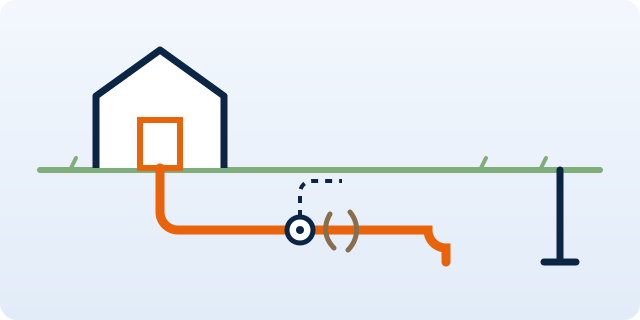
If your water and sewer bill jumped again this year, you are not imagining it. Utilities across California are in the middle of a wave of rate increases larger than the usual annual creep: San Diego raised water rates 14.7% and sewer rates 6% at the start of 2026, California Water Service (Cal Water) received approval for a 3% interim increase effective January 1, 2026 across most of its service areas, Roseville added roughly $4.69 to the typical monthly bill in the 2025-26 fiscal year with another $5.57 coming in 2026-27, and San Francisco's utility has proposed increases that would push the average combined water-and-sewer bill from about $171 a month to $189 by July 2026 and $212 by July 2027 — a combined rise of roughly 12.5% a year. Every water district sets its own rates, so the exact number on your bill depends on where you live, but the direction is the same almost everywhere in the state.
Why rates are rising faster than usual
Most California water and sewer rate increases go through a process set by Proposition 218, the 1996 ballot measure that requires public agencies to notify every property owner in writing before raising a property-related fee, and to hold a public hearing where owners can file a written protest. If a majority of parcels don't protest — a high bar, since silence counts as consent — the increase goes through. Agencies are using that process now for a few compounding reasons: pipes and treatment plants built decades ago are reaching the end of their service life and need replacement regardless of how much water moves through them; state and federal water-quality and seismic-safety mandates keep adding compliance costs; and conservation itself cuts into revenue, since a utility with mostly fixed infrastructure costs collects less money when customers use less water, which pushes rates per gallon upward even as usage falls. None of that is unique to any one city — it's the same underlying math nearly every California utility is running.
What that means for a leak you've been putting off
A slow leak — a toilet that runs after the tank fills, a worn washer dripping under a sink, a small crack in a slab line — used to be an annoyance you could reasonably defer. At 2026 rates, deferring it costs more every month it continues, and the gap only widens as the increases already approved for 2027 and beyond phase in. A 2024 study by Rupiper and colleagues, published in Environmental Research Letters, used advanced water meters to identify homes with leaks and measure what happened when residents were alerted: leaking households that acted cut their daily water use by about 30 gallons per day and saved roughly $60 a year at the rates in effect at the time (study on Google Scholar). Run that same leak through a 12-13% annual rate increase for two or three years running, and the savings from fixing it — or the cost of continuing to ignore it — grow well past that baseline.
Where to check first
Before assuming a higher bill means a leak, rule out the obvious explanations: a change in household size, a new appliance, or simply the rate increase itself showing up on a bill with the same usage as last year. Then check for a real leak with three free steps:
- Read your water meter before bed and again first thing in the morning, without anyone using water overnight. Any movement means something is running.
- Drop food coloring or a dye tablet in each toilet tank and check the bowl after 10-15 minutes without flushing. Color in the bowl means the flapper is leaking — usually a $10-30 part, one of the most common sources of wasted water in a home. Our running toilet guide covers flapper and fill-valve repair costs.
- Pull the last 12-18 months of your water bill from your utility's online account and look for a usage jump that doesn't match a lifestyle change — that's the clearest early sign of a leak that started at a specific point, rather than gradually rising rates.
When it's worth calling a plumber
A dye-test toilet or a dripping faucet is a DIY fix. A meter that keeps spinning after you've ruled those out, a warm or damp spot on the floor, or a bill that keeps climbing with no clear cause point toward something you can't see — a slab leak, a failing supply line inside a wall, or a break in the line between the meter and the house. Professional leak detection uses acoustic and thermal equipment to pinpoint the source without tearing out flooring on a guess, typically running $150-$500 depending on the property and how hard the leak is to isolate; if the leak turns out to be under a slab, our slab leak guide covers what repair actually costs and how insurers typically treat sudden versus gradual leaks. Our hidden leak guide walks through the fuller list of causes if the meter and dye tests don't turn up an obvious answer.
The bottom line
Rate increases like the ones moving through San Francisco, San Diego, Cal Water's territories and Roseville right now aren't going to reverse — utilities are explicit that these fund infrastructure they can't put off any longer. What that means for a homeowner is straightforward: the payback period on fixing a leak just got shorter, and it keeps getting shorter with every approved increase. If your own water district's rates have gone up this year, that's worth checking directly on your utility's billing page or its most recent Proposition 218 notice, since the numbers above vary by agency and none of them apply uniformly statewide.
If your bill has jumped and the DIY checks above don't explain it, a local plumber can find the source before it costs you another billing cycle. Request a free quote on Plumber Comparator and get matched with leak-detection specialists near you, including in San Francisco and San Diego, two of the markets seeing the steepest rate increases this year.
Need a plumber you can trust?
Tell us about the job — a licensed California plumber gets back to you with a real quote.
Get free quotes