Garbage Disposals and Septic Systems in California: Is It Safe, and What Does It Cost?
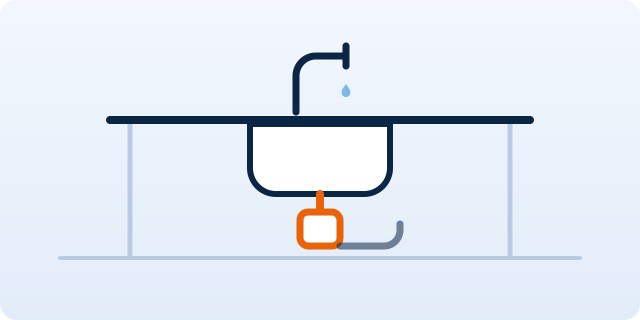
A garbage disposal is one of the most ordinary fixtures in a California kitchen — until the house is on a septic system instead of a sewer connection. Then the same question comes up every time: will grinding food scraps into the tank overload it? The honest answer is nuanced. A disposal will not destroy a healthy septic system overnight, but it does change the math on pumping frequency, tank sizing and drainfield longevity, and the rural and mountain counties where septic is common in California have their own permitting quirks on top. Here is what actually happens inside the tank, what it costs either way, and how to decide.
What a garbage disposal actually does to a septic tank
A septic tank works by settling: solids sink to become sludge, fats and grease float as scum, and the clarified water in between flows out to the drainfield. A garbage disposal adds ground food solids directly to that mix — material that a sewer-connected household simply flushes into someone else's treatment plant. A controlled study by Lin, Wang, van Lierop, Zamalloa, Furlong and Keleman, published in Waste Management & Research (2019), fed a simulated septic tank a typical daily dose of disposer food waste for 110 days and measured the effect directly: total suspended solids rose 31.3% and chemical oxygen demand rose 46.3% compared with a control tank, and while most of the added food solids biodegraded, a meaningful share still accumulated as extra sludge and scum (study on Google Scholar). In practical terms: disposal use adds real organic load, most of it breaks down, but the leftover accumulation still eats into how long the tank can go between pump-outs.
The pumping-frequency trade-off
- A typical California septic tank with normal household use needs pumping roughly every 3–5 years — see our full septic tank pumping cost guide for sizing and price detail.
- Regular garbage disposal use commonly shortens that interval to roughly every 2–3 years, and heavy daily grinding in a large household can push it toward annual service.
- A standard residential pump-out in California commonly runs $300–$700, so cutting the interval by a third to a half is a real recurring cost, not a rounding error over a decade of ownership.
- Skipping pump-outs to save money is the expensive mistake: an overloaded tank pushes solids into the drainfield, and drainfield rehabilitation or replacement is a five-figure job — our drainfield repair cost guide covers that failure mode.
Does California require anything specific?
California does not ban garbage disposals on septic systems statewide, but septic systems themselves are permitted and sized locally — county Environmental Health departments (not the state directly) approve the tank size, and sizing is generally based on bedroom count and expected wastewater flow. Two practical points follow:
- Retrofitting a disposal onto an existing septic system that was sized for the minimum without one is worth a call to your county's Environmental Health department; on an older or already marginal system, some counties want the added load reflected in the design, and a licensed septic contractor can confirm whether your tank has margin.
- New construction or a septic-to-sewer situation is a different calculation entirely — if you are already re-plumbing, our septic-to-sewer conversion guide and new construction rough-in guide cover the bigger picture.
- Homes on both a private well and a septic system — common across the Sierra foothills, the Central Valley and rural North Coast — should keep both systems on a maintenance schedule; a failing drainfield near a well is also a water-quality risk worth checking with our well water testing guide.
If you install one anyway: how to do it responsibly
- Choose a septic-rated model. Some disposal manufacturers sell units specifically marketed for septic use, often paired with a bio-charge additive that seeds extra bacteria; treat the additive claims skeptically but the mechanical build quality (motor size, grind chamber) is real and worth paying for over a bargain unit.
- Grind less, not more. Coffee grounds, eggshells, fibrous vegetable trimmings (celery, corn husks) and starchy scraps (rice, pasta) are the worst offenders for building sludge — a countertop compost bin diverts the bulk of what people reflexively grind.
- Never grind grease or oil down any drain, septic or sewer — it solidifies in the line and thickens the scum layer; our garbage disposal troubleshooting guide covers the jams and smells that follow.
- Space out use — running the disposal continuously through a big cleanup dumps a slug of solids into the tank at once. Smaller, spaced loads let the tank settle normally between doses.
- Watch for the warning signs of an overloaded system: slow drains throughout the house, gurgling, sewage odor near the tank or drainfield, or unusually lush grass over the leach lines — all reasons to call for an inspection sooner than the calendar says.
Cost comparison: install and adjust, or skip it
- Installing a disposal: commonly $300–$900 installed for a standard unit — see our garbage disposal installation cost guide — plus the shortened pump-out interval above, which over 15 years can add roughly one to two extra pump-outs' worth of cost.
- Skipping the disposal: scraps go to the trash or a compost bin instead; zero added load on the tank, at the cost of one more thing to carry to the curb.
- Already have one and it's leaking or failing: our disposal leak repair-or-replace guide covers that decision — a septic household is a reasonable moment to weigh whether to replace it at all.
For most California homes on septic, the realistic verdict is: a disposal is fine in moderation, paired with a shorter pump-out schedule and reasonable habits, but a household that composts or trashes scraps is doing its drainfield a genuine favor. Neither choice is wrong — it's a maintenance-cost trade-off, and now you have the numbers to make it.
Get your septic system evaluated by someone who knows the county rules
Septic and disposal questions are local: what your county's Environmental Health department expects, and what your specific tank can handle, varies by address. Homeowners in Santa Rosa, Murrieta and Redding use Plumber Comparator to compare licensed plumbers who work septic properties regularly. Request a free quote and ask directly whether your tank has room for a disposal before you buy one.
Need a plumber you can trust?
Tell us about the job — a licensed California plumber gets back to you with a real quote.
Get free quotes