Low Water Pressure at Just One Faucet? Aerator, Cartridge, and Shutoff Valve Diagnosis (California Cost)
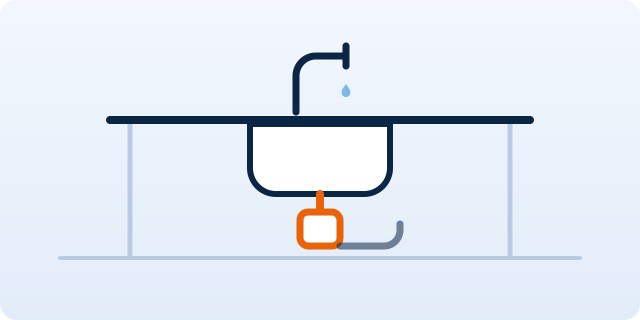
Every other fixture in the house runs fine, but one faucet — often the kitchen sink or a specific bathroom — has turned into a trickle. That pattern is actually good news: when only one fixture loses pressure while the rest of the home is normal, the cause is almost always local to that faucet, not a house-wide supply problem, a failing pressure regulator, or a leak somewhere in the walls. This guide walks through the three most common culprits in the order a plumber would actually check them, what each fix costs in California, and the one situation where a single weak faucet does point to something bigger.
Start here: rule out a house-wide cause first
Before assuming it's local, run water at a second fixture at the same time. If pressure drops everywhere when two things run at once, that's normal supply-and-demand behavior, not a fault. If only the one faucet is weak no matter what else is running, and hot and cold both feel restricted at that fixture, the problem lives inside that faucet or its immediate supply line — not in the street main, the meter, or a whole-house pressure regulator. (Low pressure that's confined to every fixture in one room, like just the shower, points somewhere different — see our shower-only low pressure guide if that's your case instead.)
Cause #1: a clogged aerator (the most common by far)
The aerator is the small mesh screen threaded onto the tip of the spout, and it is by far the most frequent reason a single faucet loses flow. Its job is to mix air into the stream for a softer, splash-free flow while using less water — but that same fine screen is exactly what traps mineral scale, sediment, and small debris over time. In California's harder-water regions especially, calcium and magnesium deposits build up on the mesh until the openings narrow to almost nothing; see our hard water in California guide for which parts of the state see this fastest.
- How to check it: unscrew the aerator by hand or with pliers wrapped in a cloth (to avoid scratching the finish), and run the faucet without it. If flow is strong with the aerator off, that confirms the clog.
- DIY fix: soak the aerator in white vinegar for a few hours to dissolve scale, then rinse and reassemble — effectively free, and the single most common fix for this exact complaint.
- Replacement, if it's damaged or corroded beyond cleaning: a new aerator costs roughly $3–$20 at any hardware store; a plumber charging a service call to diagnose and swap one typically runs $75–$150 total.
This isn't just a plumbing folk remedy — it's a documented efficiency mechanism. A 2023 study published in Energy Efficiency by Cabrera, Njem, Bertholet, and Patel measured flow restrictors and aerators installed on faucets and showerheads and found they cut measured water use at the fixture by roughly 20–33%, with the savings depending directly on how unobstructed the device's mesh stays over time (study on Google Scholar). In other words, the same fine screen engineered to save water is also the part that silently throttles a faucet to a trickle once it scales up — cleaning it restores both flow and the efficiency it was designed for.
Cause #2: a worn or clogged cartridge inside the faucet body
If pulling the aerator off doesn't fix it, the restriction is further upstream — usually the cartridge (or, on older two-handle faucets, the valve stem and washer) that controls flow inside the faucet handle itself. Sediment loosened from galvanized or older copper supply lines, or mineral scale forming directly on the cartridge's internal passages, gradually chokes off flow the same way an aerator does, just somewhere you can't see or clean with vinegar alone.
- How to check it: with the aerator still off, if flow is still weak from the bare spout, the restriction is inside the faucet body, not at the tip.
- Parts cost: a replacement cartridge typically runs $15–$60 depending on brand, plus the labor to shut off the fixture's supply, disassemble the handle, and reseat everything without cross-threading a fitting.
- Installed cost with a plumber: roughly $150–$350 total for a straightforward cartridge swap on an accessible kitchen or bathroom faucet, similar to the range covered in our faucet repair cost guide (a worn cartridge is also the leading cause of a faucet that drips instead of, or in addition to, running weak).
If the faucet is old enough that the exact cartridge is no longer stock at a supply house, or the handle assembly is proprietary to a discontinued line, a plumber may recommend replacing the whole faucet rather than chasing a hard-to-find part — worth asking about before committing to a repair-only visit.
Cause #3: a supply valve that isn't fully open
The angle stop — the small oval or lever valve under the sink where the flexible supply line connects to the wall — is a simple, overlooked culprit. If it was ever closed for a repair and not reopened all the way, or if it's an older multi-turn valve that's partially seized with mineral deposits, it restricts flow to that one fixture even though everything upstream is fine.
- How to check it: look under the sink and confirm both hot and cold angle stops are turned fully counter-clockwise (open). A valve that's stiff, leaking at the stem, or won't turn smoothly is worth having replaced rather than forced.
- Replacement cost: a straightforward angle stop valve swap typically runs $100–$250 installed; older multi-turn valves are often upgraded to quarter-turn ball valves at the same visit for reliability.
When a single weak faucet is actually a bigger warning sign
There is one pattern that doesn't fit the "just that faucet" explanation: if the weak flow came on suddenly, is accompanied by sputtering or air spitting from the tap, or the water runs cloudy or discolored before clearing, that can point to a break or repair elsewhere in the supply line stirring up sediment, or air entering the system — worth a look at our air in water pipes guide. And if weak flow at one fixture keeps recurring within weeks of a cleaning or cartridge swap, that's usually a sign of an aging galvanized supply line shedding rust from the inside rather than a problem with the faucet itself — see our galvanized pipe guide for what that repair actually involves.
The bottom line
For the large majority of single-faucet pressure complaints, the fix is cheap and fast: start with the aerator (free to check, a few dollars to replace), move to the cartridge if that doesn't solve it ($150–$350 installed), and check the angle stop valve along the way. It's a reasonable DIY project for anyone comfortable turning off a supply valve, but if the cartridge is seized, the valve won't budge, or the same faucet keeps losing pressure after a fix, a licensed plumber can usually resolve it in a single visit. Describe the faucet, how long it's been weak, and what you've already tried on Plumber Comparator and request a free quote — homeowners in San Jose, Fresno, and across California can also start from their city page for local faucet and sink repair pricing.
Need a plumber you can trust?
Tell us about the job — a licensed California plumber gets back to you with a real quote.
Get free quotesKeep reading
- Selling Your California Home? The Plumbing Issues a Buyer’s Inspector Will Flag — and What to Fix First
- Smart Water Leak Detectors & Automatic Shutoff Valves in California: Cost, Installation, and Insurance Discounts
- Is California Tap Water Fluoridated? The Law, the Levels, and How to Filter It Out If You Want To