Grinder Pump (Low-Pressure Sewer) Systems in California: Cost and Who Is Responsible
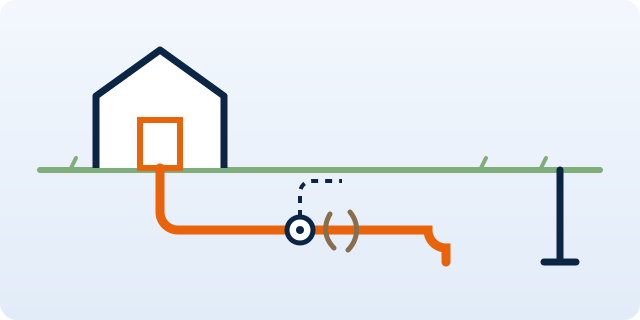
Most California homes send wastewater downhill through a gravity sewer line and never think about it again. But if your neighborhood sits on flat ground, hillside terrain, or was recently converted from septic to sewer, there's a decent chance your house instead has a small tank in the yard with a grinder pump inside it — a pump that shreds solid waste into a slurry and pushes it, under pressure, into the public sewer. It's a completely different animal from the sewage ejector pump some homes use for a basement or garage bathroom, and it comes with its own cost profile, ownership questions and failure mode.
What a grinder pump actually does
A conventional gravity sewer relies on slope: pipes big enough (6–8 inches) that solids just flow downhill to a treatment plant. That doesn't work everywhere — flat lots, hilly terrain, high groundwater, or rocky/unstable soil that makes deep gravity trenching expensive all push utilities toward a low-pressure sewer (LPS) instead. In an LPS network, every connected property has its own grinder pump in a sealed underground tank. Wastewater collects in the tank, the pump macerates solids into a fine slurry, and a small pipe (often 1.25–2 inches, versus 4-inch gravity laterals) pushes it into a shared pressurized force main running down the street. It's the same basic idea as a sewage ejector pump, but built to handle raw sewage solids and to work against real pressure over real distance, not just lift water a few feet to a gravity line.
This setup shows up most often in California in three situations: hillside subdivisions where trenching a gravity main would mean deep, expensive excavation (documented, for example, in hillside neighborhoods around Riverside); lakefront or low-lying developments with a high water table; and areas going through a septic-to-sewer conversion, where running a full gravity main to every existing lot isn't practical and a pressure system lets the city connect homes without regrading the whole street.
What installation and replacement actually cost
Figures below are broad, nationally observed ranges from 2026 pricing guides — no California-specific survey exists, so treat them as a starting point for a quote, not a quote itself:
- Grinder pump unit alone: roughly $800–$2,500, depending on horsepower and brand.
- Full residential system installation (new construction or septic-to-sewer conversion): roughly $2,500–$8,000 total, including the tank, pump, controls and trenching to the property line.
- A standard install with a 50–100 foot run to the connection point tends to land around $3,000–$6,500; longer runs, rocky soil, or a need to bore under a driveway or hardscape push it toward the top of the range or beyond.
- Replacing just the pump in an existing tank (unit plus labor, no new trenching) is usually well under a full new install — closer to the unit cost plus a few hundred dollars of labor, though a pump that's seized or corroded in place can run longer.
- Electricity to run the pump is a minor ongoing cost — commonly cited in the range of $12–$20 a year, since the motor only runs in short bursts.
Compare that against the cost of a conventional sewer line repair on your property before assuming a grinder pump replacement is automatically the pricier option — for a hillside lot, the pressure system is often the cheaper path precisely because it avoided a deep gravity trench in the first place.
Who is actually responsible for it
This is the part homeowners most often get wrong, and there is no single answer across California — it depends entirely on how the local sewer authority set the system up. In some networks, the utility owns and maintains the grinder pump itself, treating it as an extension of the public system. In others, the utility owns only the shared pressure main in the street, and everything on the private side — the tank, the pump, the wiring, the check valve and the private lateral running from your house to the tank — is the homeowner's property and the homeowner's repair bill, the same way a driveway sewer lateral is the homeowner's responsibility under most agreements.
Don't guess. Call your local sewer or public works department and ask directly which category your connection falls into, and ask for it in writing if you're buying a house that has one — a grinder pump you didn't know you owned is an unpleasant thing to discover mid-escrow. Manufacturer warranties on the pump itself are typically short (around one to two years) and generally exclude damage from misuse, so past that window, a failure is a straightforward repair bill either way if the unit is privately owned.
What to do when the alarm goes off
Every grinder pump tank has a high-water alarm — usually a warning light, a horn, or both — that trips when the pump isn't keeping up with what's coming in. That can mean a failed pump, a tripped breaker, a stuck check valve, or (less often) something jamming the grinder mechanism. Treat the alarm the way you'd treat a smoke detector, not background noise: keep water use to a minimum until it's addressed, and don't ignore a horn that's been going for hours hoping it resets itself. Many systems' own operating rules call for getting the pump serviced within about a day of an alarm, precisely because a full tank backs up into your house, not the street. If you're not sure whether your system is privately owned, this is exactly the moment to find out, since it determines whether you call your utility or a licensed plumber.
What not to put down the drain, even with a grinder
A grinder pump handles ordinary toilet paper and normal solids fine, but it is not a garbage disposal. Wipes marketed as "flushable," paper towels, feminine products, dental floss and grease all cause the same jams and premature wear in a grinder tank that they cause in a gravity line — arguably worse, since a jammed grinder motor burns out trying to force through material it can't cut. The habits covered in our guide to flushable wipes and clogged drains apply here without exception.
The broader economics, briefly
There's surprisingly little published academic research specifically on grinder pumps, but the underlying economics of non-gravity sewer collection is a genuine engineering research topic. A 2017 study by M. Shafiqul Islam in the International Journal of System Assurance Engineering and Management, comparing vacuum sewer systems against conventional gravity sewers for the same service area, found that alternative collection systems needing far less excavation — about a quarter of the trenching depth and cost of gravity sewer in the case studied — carried meaningfully lower total construction and operating costs, particularly where terrain made deep gravity trenching expensive (study on Google Scholar). Pressure sewer with grinder pumps is a different alternative technology than vacuum sewer, but it's built on the same underlying tradeoff: pushing more of the system's complexity into small pumps at each house, in exchange for avoiding the excavation cost of gravity pipe on difficult terrain. That's the same reason your city chose it for your street in the first place.
If your grinder pump has failed, is alarming, or you're weighing a private repair against a call to your sewer utility, request a free quote and describe the system you have — a plumber experienced with pressure sewer connections (not every plumber is) can tell you quickly whether the fix is on your side of the property line.
Need a plumber you can trust?
Tell us about the job — a licensed California plumber gets back to you with a real quote.
Get free quotes