Why Your Toilet or Drain Backs Up When It Rains in California
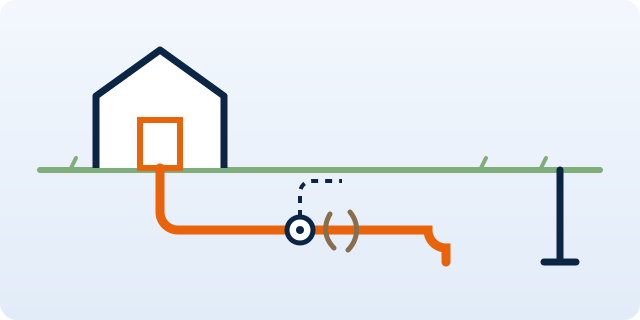
If a toilet gurgles, a shower drain backs up, or sewage smell shows up in your house specifically during or right after a heavy rain, that is not a coincidence and it is not "just how old houses are." Rain and sanitary sewage are supposed to travel in completely separate pipe systems. When they don't stay separate — because of aging pipe, a shared system, or a low fixture with no backflow protection — a storm can push sewage backward into your home instead of water flowing out of it. Here is the actual mechanism, why it is worse in some California neighborhoods than others, and what stops it.
Rain and sewage are supposed to be two different systems
Almost every California city runs two separate underground networks: a storm drain system that carries rain runoff from streets and roofs to creeks, rivers or the ocean, and a sanitary sewer system that carries wastewater from toilets, sinks and showers to a treatment plant. They are not supposed to connect at all. When your indoor plumbing reacts to weather, it means water is getting into the sanitary side of that split — either through cracks in an aging pipe or, in one specific California city, because the two systems were never fully separated in the first place.
San Francisco is the outlier: it is the one California city that still runs a true combined sewer system, where stormwater and sewage share the same pipes by design, a fact the SFPUC documents on its own site. During intense storms, that combined flow can exceed what the treatment plant and pipe network can carry, and in low-lying parts of the city it can back up through building plumbing before it ever reaches the plant. If you're in San Francisco and this happens repeatedly in the same storm-prone area, that citywide system design — not a defect specific to your house — is part of the story.
Everywhere else: inflow and infiltration, not a shared pipe
For the rest of California, the sanitary sewer is physically separate from the storm system, but an aging or damaged one can still let rainwater in — a process utilities call inflow and infiltration, or I&I. Infiltration is groundwater seeping in through cracked pipe joints, root-damaged clay or old cast iron once the soil around it saturates. Inflow is more direct: a downspout illegally tied into a sewer cleanout, a cracked cleanout cap sitting below grade, or a sump pump discharging into the sanitary line instead of outside. Either way, a pipe that normally carries a trickle of household wastewater suddenly has to carry stormwater on top of it, and the sewer main — sized for dry-weather flow — can't keep up.
The effect on a house is the same whichever mechanism causes it: water backed up in the main sewer has nowhere to go but back up the path of least resistance, which is often the lowest drain or toilet in the building. A 2017 hydraulic modeling study published in the journal Water by Nasrin, Sharma and Muttil found that short, intense rainfall bursts — not just prolonged steady rain — are a primary driver of this kind of rainfall-derived infiltration and inflow into aging sanitary networks, and that the risk of overflow rises sharply as storm intensity increases (study on Google Scholar). That matches what California homeowners actually report: backups tend to hit during the first hard, fast storm of the season more than during a slow, gentle rain — partly because summer-dry ground and pipe joints take that first serious wetting the hardest.
Which houses are actually at risk
Not every home in a rainy neighborhood backs up. The ones that do usually share one of these:
- A fixture below street level. A basement bathroom, a below-grade laundry room, or a garage floor drain sits lower than the sewer main in the street. If the main surcharges (fills completely) during a storm, anything below that level is the first place water reappears.
- An old lateral with root intrusion or cracked joints. Clay and cast-iron laterals from mid-century-era neighborhoods are the most common infiltration source; see our root intrusion in sewer lines guide for how roots find and widen those cracks over years.
- No backwater valve where one is needed. California Plumbing Code requires a backwater valve on drainage piping serving fixtures below the level of the next upstream manhole — but plenty of older homes predate that requirement or never had one added. Our backwater valve installation guide covers what the device does, the code trigger, and what a retrofit costs.
- Poor yard drainage pushing water toward the foundation and lateral. Downspouts or grading that dump roof runoff right next to the house saturate the soil around the lateral fastest, which is exactly where infiltration through a compromised pipe starts. A French drain that redirects that water away from the foundation reduces the load on the pipe underneath it.
What actually fixes it — and what doesn't
Running a snake down the drain that backed up treats a symptom that will return with the next storm, because the problem usually isn't a clog inside your house — it's a system that's temporarily full. The fixes that address the actual cause:
- Get your lateral cameraed. A sewer camera inspection is the only way to see whether your own lateral has root intrusion, offset joints, or a belly that's letting groundwater in — and it's far cheaper than guessing.
- Install a backwater valve if you don't have one and have a low fixture. This is the single most direct fix for backups specifically tied to storms, because it physically blocks reverse flow into your house even while the street main is surcharged.
- Fix a cracked or submerged cleanout cap. A cleanout at or below grade that's cracked, missing its cap, or sits in a low spot where rain pools is a direct inflow point that's cheap to correct once found.
- Redirect surface water away from the lateral's path with grading or a French drain, so the ground around an aging pipe isn't saturated every time it rains.
If your sewer main is genuinely undersized or badly deteriorated over a long run, the city-side fix is out of your hands — but confirming that with camera footage, rather than assuming it, is what tells you whether the next call is to your city's public works department or to a plumber for lateral work on your side of the property line.
If a storm has already caused a backup in your home, don't run more water through the affected fixtures until you know the cause — see our guide on what to do while waiting for an emergency plumber for the immediate steps. Once things are stable, request a free quote and describe when the backup happens — during rain, right after, or randomly — so a local licensed plumber can start with a camera inspection instead of a repeat snake job that won't hold through the next storm.
Need a plumber you can trust?
Tell us about the job — a licensed California plumber gets back to you with a real quote.
Get free quotes