Gas Line for a Range or Cooktop in California: Cost and Code
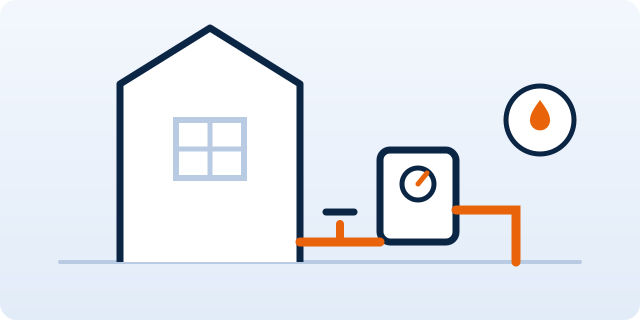
Two homeowners can ask for "a gas line for the stove" and get quotes that differ by a factor of five. That is not price gouging — the phrase covers two different jobs. One is moving a stub-out that already exists behind the range. The other is bringing gas into a kitchen that never had it: routing new pipe from elsewhere in the house, verifying the meter and existing piping can carry the load, pulling a permit, passing a pressure test.
Job one: moving or extending an existing stub-out
If there is already a capped gas outlet in the kitchen — behind the old range, under a cooktop cabinet, or feeding a wall heater on the far side of the same wall — you are in the cheap version of this project. The plumber shuts off the gas, cuts in at the existing line, adds a few feet of black iron or corrugated stainless steel tubing, sets a new accessible shutoff valve, and reconnects. Short relocations commonly land in the $200 to $700 range. This is the usual remodel scenario when the range moves to a new wall or island — a small line item next to the water and drain work in our kitchen remodel guide.
Job two: a brand-new run (the electric-to-gas conversion)
If the kitchen has never had gas — common in all-electric tract housing and condos — the plumber has to find gas elsewhere and bring it to the range. Pricing is quoted per linear foot installed, and the two ends are far apart:
- Simple runs, roughly $15 to $25 per foot. An accessible attic or a crawl space under a raised foundation, a straight shot, few fittings, drywall opened in one or two spots.
- Complex runs, roughly $35 to $50+ per foot. Slab-on-grade homes with no crawl space, where pipe goes up into the attic and back down inside a wall or gets trenched around the perimeter. Also multi-story routing, and paths cutting through cabinets, tile backsplash or a soffit that then need patching.
Because ranges are often far from the meter, a full new run frequently totals high hundreds to low thousands once labor, fittings, valve and patching are included. The biggest variable is not the pipe — it is the path, so ask every bidder to walk you through the route and what gets opened up. Our general gas line installation cost guide covers other appliances, and the gas line cost hub has California-wide ranges.
Why the rest of the house affects your kitchen quote
A gas system is sized as a whole, not appliance by appliance. Under the longest-length method in NFPA 54 — adopted by the California Plumbing Code — a plumber adds up the BTU-per-hour input of every appliance, measures the distance from the meter to the most remote one, and checks each segment is large enough at an acceptable pressure drop. A range plus oven adds real load, and if the house already runs a furnace, water heater, dryer and maybe a pool heater, one more appliance can push a section of existing pipe past its rated capacity. The fix is upsizing that segment or, less often, the meter itself — the most common reason a "simple stove line" quote comes back high, and why a plumber who has not seen your meter cannot quote by phone.
What the connection at the appliance has to include
The last few feet are where inspectors look hardest, and where DIY work most often fails:
- An accessible manual shutoff valve in the same room as the appliance, within about six feet of it, upstream of the flexible connector. "Accessible" is doing real work there — a valve behind a fixed cabinet panel does not satisfy it.
- A listed flexible appliance connector between the valve and the range, so the appliance can be pulled out without stressing rigid pipe. The connector may not pass through a wall, floor, partition or ceiling — it stays in the open, in the appliance's space.
- CSST bonding, if corrugated stainless steel tubing is used. CSST must be electrically continuous and bonded to the service grounding electrode system with a jumper no smaller than 6 AWG copper, using listed clamps — see our CSST bonding guide.
- A sediment trap — except here. Code requires a sediment trap (drip leg) downstream of the shutoff for most gas appliances, but ranges, clothes dryers, decorative fireplace appliances and outdoor cooking appliances are explicitly exempt. If the inspector does not ask for one, that is not an oversight.
Permit and pressure test
New or extended gas piping is permitted work in essentially every California jurisdiction, with fees commonly in the $50 to $200 band. The inspection has a specific technical step: the piping is capped at every outlet and pressurized with air or nitrogen to at least 10 psi, and must hold that pressure at least fifteen minutes with no perceptible drop on a gauge graduated in tenths of a pound. Rough inspection comes before walls close. Our pressure test guide covers what happens if it fails; if you smell gas at any point, treat it as an emergency and read gas leak safety.
Ventilation is part of the install, not an accessory
A gas cooktop is a combustion appliance inside your living space, and the research is solid. A 2022 study by Lebel, Finnegan, Ouyang and Jackson in Environmental Science & Technology measured emissions in 53 homes and found gas stoves release unburned methane — most of it while the appliance sits idle, from post-meter fittings — plus nitrogen oxides in proportion to gas burned (study on Google Scholar). A 2013 meta-analysis by Lin, Brunekreef and Gehring in the International Journal of Epidemiology, pooling 41 studies, found an association between gas cooking and childhood asthma (study on Google Scholar).
The takeaway is not that you should not cook with gas — it is that a hood which actually vents outdoors, sized for the cooktop and used every time, is part of doing this properly. A recirculating hood does not remove combustion products, so if that is all the kitchen has, budget for ducted venting too.
Going the other way: capping the line for induction
Plenty of homeowners are going the opposite way, replacing a gas range with induction. That job is small on the plumbing side: shut off the gas, disconnect the connector, cap the line properly. Simple capping at an accessible stub commonly runs about $75 to $200; removing the branch back to its source costs a few hundred, and a permit may still be required — see our capping and abandoning a gas line guide. The real cost of an induction conversion is electrical, not plumbing: a dedicated 240-volt circuit, which is an electrician's scope.
What about California cities restricting gas?
A number of California municipalities adopted all-electric requirements, several of which have since been challenged, repealed or made voluntary after federal preemption litigation. The part that matters here: these ordinances target new construction, not appliance replacement in an existing home, so a stub-out in a house that already has a meter is normally unaffected. Local rules vary and change, so confirm with your building department before buying the appliance — especially if you are building new. For an outdoor grill, see our outdoor kitchen gas line guide.
When you gather bids, ask for the run length and route in writing, whether a gas load calculation was done, and whether permit, pressure test and patching are included — those exclusions turn a low quote into a high final invoice. Compare quotes from local, licensed plumbers in Los Angeles, San Jose, Sacramento and San Diego on Plumber Comparator, and request a free quote describing your kitchen layout and where the meter sits.
Need a plumber you can trust?
Tell us about the job — a licensed California plumber gets back to you with a real quote.
Get free quotes