What Chemical Drain Cleaners Do to Your Pipes and to People
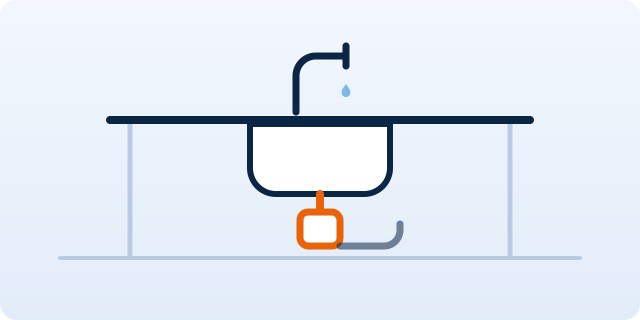
Almost every homeowner who calls a plumber about a slow drain has already tried something from the hardware store aisle. Those products are not one thing — they are three different chemistries, and each attacks something different in your plumbing. Knowing which is which explains why the bottle sometimes seems to work, why the clog comes back, and why a plumber will ask what you poured before putting a cable in the line.
Three chemical families, three different attacks
Ignore the label marketing and look at the active ingredient:
- Caustic (alkaline) cleaners — sodium hydroxide or potassium hydroxide, sometimes at very high concentrations. They work by saponification: hydroxide ions break fats into soap-like compounds that rinse away. Many formulas also carry aluminum particles, which react with the lye to generate hydrogen gas and a lot of heat.
- Acid cleaners — concentrated sulfuric or hydrochloric acid, always liquid. These dissolve hair, paper and organic matter by hydrolysis and dehydration, and generate serious heat on contact with water.
- Oxidizing cleaners — sodium hypochlorite (bleach), hydrogen peroxide, or nitrate formulas. The mildest of the three: they oxidize organic material rather than melting it, and are sold more for odor than for a hard stoppage.
All three share a weakness: they act on organic material. None touches a root mass, a collapsed pipe, a bellied section, or a wad of so-called flushable wipes packed against a fitting.
Why the damage happens in a standing trap
These products sink through standing water and sit on the blockage, so the chemistry works in a stationary column of liquid, against the same few inches of pipe wall, for as long as you leave it. A caustic product paired with aluminum is exothermic: it heats the water it sits in, and that heat has nowhere to go but into the pipe wall and the fittings around it. In a flowing pipe the reaction dilutes away in seconds; in a dead-standing trap it concentrates.
What each pipe material has to fear
- Old cast iron is the worst case. Decades-old cast iron drain lines are already scaled and pitted inside, the wall thinned unevenly. Acid attacks ferrous metal directly; caustics are gentler on iron, but heat and chemistry accelerate corrosion exactly where the pipe is weakest — at existing pits and joints. That argues for a camera inspection rather than a bottle, and our guide to cast iron drain replacement cost covers what comes next.
- ABS and PVC resist lye and most acids at room temperature — the problem is the heat, not the chemical. Softening of plastic pipe under thermal load is documented, and the vulnerable point is the solvent-welded joint, not the straight pipe.
- Rubber gaskets and couplings — no-hub bands, slip-joint washers, toilet seals. Sources genuinely disagree: some argue a single exposure is trivial, others report degradation over time. One dose is unlikely to destroy a gasket; repeated dosing over years risks a slow leak later.
A repeat clog proves the chemical did not work
If a drain cleared and then re-clogged within weeks, the chemical did not remove the cause — at best it burned a channel through soft material and left the rest. The cause is usually congealed grease on the pipe wall, scale in old metal, a low spot holding water, or roots in the sewer lateral. Our guide on drain clogs that keep coming back explains how to tell them apart, and fixture drain vs. main sewer line narrows it down.
The safety problem nobody puts on the label
The real hazard is not the pouring; it is what happens next, to whoever opens that line. A plumber running a motorized cable into a drain full of undisclosed caustic is spinning a steel snake through a standing pool of concentrated lye, and the cable throws liquid — back up the pipe, out the cleanout, onto forearms and into faces. Poison Control flags splash-back as a hazard when drain cleaner is used on a fully blocked drain.
Alkali eye injuries are the ones that end badly, because hydroxide saponifies cell membranes and keeps penetrating rather than sealing the surface the way an acid burn tends to. A study by Haring, Sheffield, Channa, Canner and Schneider in JAMA Ophthalmology in 2016 (Epidemiologic Trends of Chemical Ocular Burns in the United States) counted roughly 144,000 emergency department visits for chemical ocular burns nationally over four years, with the highest rates of any age group falling on one- and two-year-olds.
That pediatric angle is not hypothetical. Riffat and Cheng, reviewing 50 consecutive pediatric caustic ingestions in Diseases of the Esophagus in 2009 (Pediatric caustic ingestion: 50 consecutive cases), reported a median age of 22 months, alkali products in the large majority of cases, and half of the moderate-grade esophageal injuries forming strictures that needed repeated dilatation. An open container of lye under the sink is a bad idea in a house with a toddler.
So tell your plumber. Not out of embarrassment — out of basic safety. Say what you poured, how much, and when. A good technician will flush the line before cabling, or pull the trap and drain it into a bucket. Some companies charge extra to work a line with chemicals in it, and that surcharge is legitimate — hiding it just moves the risk onto someone who did not consent to it.
If you are on septic, there is a second problem
A septic tank is a live biological reactor, and a slug of concentrated caustic or bleach is hostile to the anaerobic bacteria that digest solids in it. The EPA's homeowner guidance tells septic owners to avoid chemical drain openers and use hot water or a snake instead. Same logic as our guide on garbage disposals and septic systems: anything that sterilizes the tank shortens the life of the drain field.
What to do instead, and what it honestly costs
The mechanical alternatives work because they remove material instead of dissolving part of it. A plunger followed by a cheap 25-foot hand auger clears a large share of sink and tub stoppages — our guide on home remedies and when to stop trying covers where the DIY line sits.
Typical California pricing runs about $150 to $300 for a single fixture drain cabled clear, and roughly $250 to $500 for a main line cleared through an existing cleanout. A camera inspection usually lands in the $150 to $500 range, and is worth insisting on before you pay for a third cabling of the same line. Hydro jetting versus snaking explains when the pricier option — commonly $300 to $800 for a residential sewer — is justified, and our drain cleaning cost breakdown covers what moves the price. If a very low advertised special caught your eye, read cheap drain cleaning specials first.
If you have already poured it
Do not chase it with a second product, and never mix families — a caustic with an acid, or an acid with a bleach product, can react violently and release chlorine gas. Do not plunge a drain holding chemical; that is how it ends up on your face. Run cold water if the drain takes any, ventilate the room, then call a plumber and say what is in the line. If anything reaches skin or an eye, irrigate immediately and continuously with clean water and call Poison Control at 1-800-222-1222 — alkali eye exposure is time-critical.
A blocked drain needs the blockage removed. Compare quotes from licensed plumbers in Los Angeles, Sacramento, Fresno and Long Beach on Plumber Comparator, and request a free quote — mentioning that chemicals were used, so the plumber arrives prepared.
Need a plumber you can trust?
Tell us about the job — a licensed California plumber gets back to you with a real quote.
Get free quotes