Upgrade PlannerPlumber Comparator
 Real contents page · read chapter 1 free
Before your next water heater
Water Heater Upgrade Planner: Heat Pump, Tankless and Zero-NOx Rules (California)
Before your next water heater: what your air district and the 2025 Energy Code allow, heat pump, gas tankless or tank, the panel and the 240 V line, the incentives that are really open, and the 10-year cost.
$34one payment · 10 chapters · read online, print to PDF
For $65 more: The Complete Plumbing Library, all 12 guides, 132 chapters.
- Secure checkouton Stripe's own page
- Instant accesslink + receipt by email
- 14-day full refundno questions asked
You pay → instant access + receipt by email → findable at any time (Find my purchases). Questions: admin@tech-bharat.com
- 10chapters
- 7,000+words of California-specific guidance
- 14official texts and studies linked
- Octoberlast update (2026)
- Primary sourcesAcross our 12 guides: 111 official texts and studies, linked right where they are used. 20 studies cited by DOI.
- Every rule tied to its sourceEach California rule links the code section it quotes. Prices match our free cost pages, method published.
- Dated updatesLast update November 2, 2026. You always read the latest version.
Built from the codes and guidance of the California Legislature (state codes), the Contractors State License Board (CSLB), the US EPA, the US Consumer Product Safety Commission and the State Water Resources Control Board. Published by Clément Lacaille, Tech-Bharat · How we research
- Read online right after payment, on phone or computer; print it from your browser
- 10 chapters · updated October 31, 2026
- Full refund on request within 14 days, no questions asked (terms of sale)
Who it is for
- California homeowners whose water heater is 7 years old or more and who want to choose the next one before it fails
- Bay Area and Southern California owners who keep hearing about zero-NOx deadlines and want to know what they mean for their address
- Anyone holding a heat pump or tankless quote that is thousands of dollars above a plain tank and wondering where the difference goes
In pictures
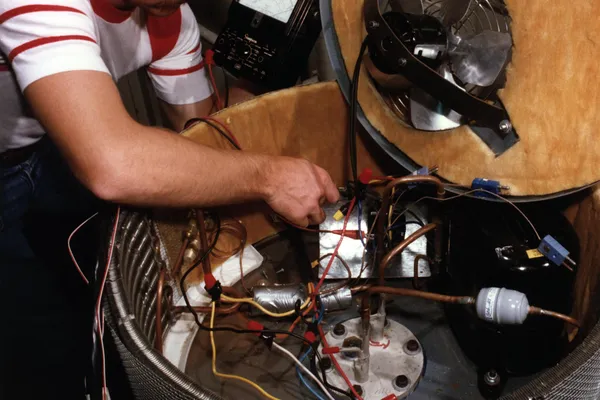

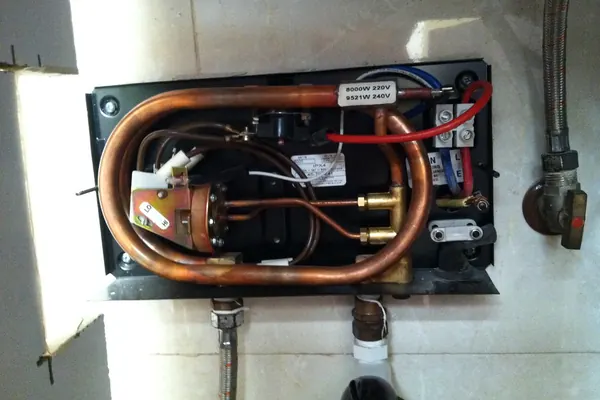
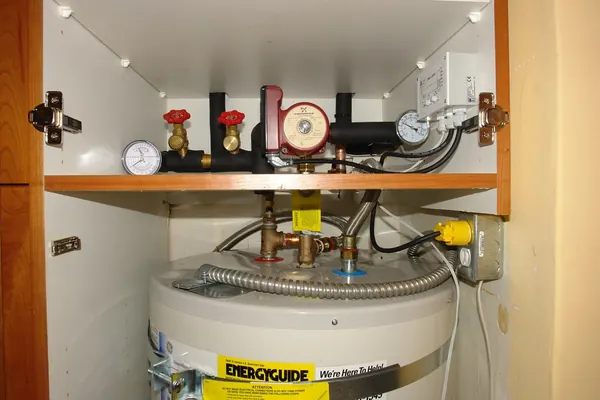
Illustrative photos, published by their authors under free licenses.
What is inside
- What the rules allow at your address in 2026
- Heat pump, gas tankless or a new tank: the choice in one table
- Sizing each technology
- Space, air, condensate, venting and noise
- The electrical panel and the 240 V line
- Incentives that are really open (checked October 29, 2026)
- The 10-year cost, worked out from our prices
- Quote sheets by technology
- Permit and inspection checklist
- Replace before it fails: the calendar
Which one do you need?
Complete Library
$99
132 chapters · $8.25 per guide · vs $330 separately
Get the library: $99- Price Book: 17 jobs priced, 145 cities' labor ratesif you pick it✓✓
- Sewer line kit, slab leak and insurance claim kit with 3 letters–✓✓
- Water Heater Replacement Kitif you pick it✓✓
- 9 project guides: Home Water Quality Planner, Repipe Planner, Bathroom & ADU Plumbing Planner, Earthquake & Gas Safety Kit, Home Buyer's Inspection Kit, Drain & Sewer Clog Playbook, Water Heater Upgrade Planner, Kitchen Plumbing Planner, Bathroom Fixture Plannerone of them–✓
- House plumbing record and 10-year budget––✓
- Instant access, read online, print to PDF✓✓✓
- 14-day full refund, no questions asked (terms of sale)✓✓✓
14-day full refund, no questions asked · terms
Free preview: introduction and chapter 1
A water heater used to be a like-for-like purchase: the old tank leaks, the plumber brings the same size, the job is done by evening. In California that is no longer the whole story. Two Bay Area and Southern California air districts have set zero-NOx dates for gas water heaters, the 2025 Energy Code changed what new homes start from, the federal tax credit ended with 2025, and the state rebate money for single-family homes is reserved. Meanwhile the quotes have spread apart: a plain gas tank, a gas tankless unit and a heat pump water heater can be thousands of dollars apart for the same closet.
The Water Heater Replacement Kit on this site helps you buy a replacement well. This planner goes one step earlier and further: it is for choosing the technology, ideally before the old unit fails. It starts with what the rules allow at your address today and on the dates already written, district by district. Then it compares heat pump, gas tankless and tank on the questions that decide the price: size, space and air, condensate, noise, venting, the gas line, the electrical panel and the 240-volt line. It lists the incentives that were open on the day we checked the official pages, and how to confirm one in writing. It works out a 10-year cost from our own price ranges, with the line for your energy bill left for you to fill from the label. And it gives you a quote sheet per technology, a permit and inspection checklist, and a calendar to replace on your schedule rather than the tank's.
Plumber Comparator is a research and referral site published by Clément Lacaille (Tech-Bharat). We are not plumbers, electricians or lawyers: your building department, your air district and a licensed contractor who has seen your house have the last word. Every price is a typical California range from our cost pages, not a quote. Rules, draft rules and incentive status were checked on the official pages on October 29, 2026; the Bay Area district had a board vote scheduled for November 4, 2026, so chapter 1 tells you exactly what to re-check.
1. What the rules allow at your address in 2026
Three separate systems decide which water heater can go into a California house: the regional air district (emissions), the state Energy Code (efficiency), and your city (permits, and sometimes its own local code). They are written by different agencies on different schedules. A plumber who says "gas is banned" or "nothing has changed" is usually describing only one of the three.
Step 1: find your air district
California has 35 local air districts. Your installer knows yours; your property tax bill and your county's website name it too. For water heaters, two districts have rules that change the choice in the next few years:
- Bay Area Air Quality Management District (BAAQMD): all or part of the nine Bay Area counties.
- South Coast Air Quality Management District (SCAQMD): the urban parts of Los Angeles, Orange, Riverside and San Bernardino counties.
Other districts set their own emission limits for gas water heaters. Ask your installer which limit applies at your address and check that the quoted model is certified for it.
The Bay Area: Rule 9-6 and its pending amendments
In March 2023 the Bay Area district amended Regulation 9, Rule 6 to require a zero-NOx standard for covered water heaters, starting with units manufactured after January 1, 2027 for water heaters under 75,000 BTU per hour (essentially every residential gas tank) and 2031 for larger units, which include most gas tankless models. In practice no gas burner meets a zero-NOx standard, so a compliant unit is electric, usually a heat pump water heater. The rule applies to what is sold and installed after the date: a gas water heater already working in your house does not have to come out.
The district has since proposed to soften its own rule. Its July 2026 draft amendments, followed by a proposed package released in October 2026, would:
- Move the dates to January 1, 2028 for water heaters under 75,001 BTU per hour and January 1, 2033 for larger ones (typically tankless, commercial and multifamily units).
- Allow a gas water heater with an Exemption Certificate obtained before installation for: owners enrolled in qualifying low-income programs (the draft lists Covered California, Medi-Cal, food assistance, energy rate assistance and SSI); "housing cost-burdened" owners whose yearly mortgage and property tax are at least 28% of household gross income (self-attested); a one-time space exemption when the existing heater sits in an enclosed space under 700 cubic feet that cannot be ventilated, a garage with a ceiling under 7.2 feet or another indoor space under 6 feet; and a one-time electrical exemption obtained by a licensed contractor, for example a panel under 100 amps, a panel with no breaker space or expansion capacity, or a new 240 V connection needing more than 50 feet of wiring.
- Allow a temporary gas unit while a compliant one is arranged (to be removed within 12 months), and exempt water heaters under 30 gallons.
The draft also gives the district's own cost estimate: an average incremental cost of about $3,500 to install a heat pump water heater on a standard project, of which $600 to $1,600 is the difference in retail price of the unit and the rest extra labor.
These amendments are not adopted as we write. The district's Board of Directors was scheduled to consider them on November 4, 2026. Before you rely on any date or exemption, read the current status on the district's Rule 9-6 page and its building appliances page. Our free guide to the proposed Bay Area exemptions explains the background.
Southern California: Rule 1121 for tanks, Rule 1146.2 for tankless
In the South Coast district, two rules split the water heaters by burner size.
- Gas tanks under 75,000 BTU per hour: Rule 1121. Since 2006 to 2008 (by tank size and vent type), every gas water heater in this class sold or installed in the district must be certified to 10 nanograms of NOx per joule of heat output, the "ultra-low-NOx" models stocked locally. A district proposal to add zero-emission targets to this rule was voted down by the district's Governing Board on June 6, 2025, so Rule 1121 continues as amended in 2004. A like-for-like ultra-low-NOx gas tank remains a legal replacement. Our ultra-low-NOx and zero-NOx guide puts the compliant-model premium at roughly $100 to $300.
- Gas units from 75,000 BTU per hour up to 2 million: Rule 1146.2, amended June 7, 2024. This class includes residential tankless (instantaneous) water heaters, whose burners are typically far above 75,000 BTU per hour. For instantaneous water heaters up to 200,000 BTU per hour, the zero-emission limit applies from January 1, 2026 in new buildings and January 1, 2029 in existing buildings. Gas units sold before then carry the label "If Installed in South Coast AQMD: For Installation and Use in Existing Buildings Only."
What it means: in an existing Southern California house, a new gas tankless water heater is legal until January 1, 2029. After that date, the replacement of a tankless unit in that class has to be zero-emission. The rule also contains a unit-age limit (25 years for instantaneous water heaters) after the compliance date, and short alternative compliance options for emergencies, leased properties and construction delays; read them in the rule text if one may apply to you.
The 2025 Energy Code (Title 24, Part 6)
The 2025 Building Energy Efficiency Standards took effect on January 1, 2026. For new homes, a heat pump water heater is the prescriptive starting point in most climate zones; gas remains possible through the performance path. For additions, the new-construction rules apply only if a water heater is installed as part of the addition.
For a replacement in an existing home, the California Energy Commission's page on single-family water heater alterations lists the allowed options: a natural gas or propane water heater; a heat pump water heater with a storage tank, with a communication interface (a CTA-2045 port or equivalent) and the tank on a rigid insulated surface of at least R-10; or a heat pump water heater meeting the NEEA Advanced Water Heating Specification Tier 3 or higher. If your existing heater is electric resistance, its replacement may be an electric storage, an electric instantaneous or a heat pump water heater. Newly installed and accessible hot water pipes must be insulated. The "electric-ready" requirements that come with a gas water heater (a 240 V-ready circuit and a condensate drain at the heater) apply to new construction and additions, not to a replacement.
In short: the state Energy Code does not force a homeowner from gas to electric at replacement. What can is an air district date, and in some cases the scope of the project (an addition or an ADU is treated closer to new construction). Our guide to the 2025 Title 24 rule for heat pump water heaters covers the details.
Your city
Since the Ninth Circuit's 2023 decision against Berkeley's ban on gas piping in new buildings, cities have largely set such bans aside, but your city still issues the permit and enforces the building codes, and some cities kept or rewrote local energy requirements. Ask the permit counter one question: "Does anything in the city's code change what I can install when I replace my water heater?" Our guide on whether cities can still ban gas water heaters explains what survived.
Your address in one table
| Where you are | Replacing a gas tank | Replacing or adding a gas tankless | Heat pump water heater |
|---|---|---|---|
| Bay Area | Legal today; zero-NOx for units made after January 1, 2027 under the adopted rule (2028 proposed), with exemptions proposed | Legal today; adopted date 2031 (2033 proposed) | Always allowed |
| South Coast | Legal with an ultra-low-NOx certified model (Rule 1121) | Legal in an existing building until January 1, 2029 (Rule 1146.2); zero-emission in new buildings since 2026 | Always allowed |
| Elsewhere in California | Legal with a model certified for your district | Legal with a model certified for your district | Always allowed |
| New home, addition with its own water heater, some ADUs | Performance path needed | Performance path needed | Prescriptive default |
That is the end of the free preview. Chapters 2 to 10 continue in the full guide.
14-day full refund, no questions asked · terms
Secure payment by StripeCard, Apple Pay or Google PayInstant accessOne-time payment, no subscription
- Read online right after payment, on phone or computer; print it from your browser
- 10 chapters · updated October 31, 2026
- Full refund on request within 14 days, no questions asked (terms of sale)
How it works
- You pay on our secure checkout (Stripe) by card, Apple Pay or Google Pay. One payment of $34, no account to create.
- You read the full guide immediately: your access link shows right after payment and arrives by email with the receipt.
- A problem with the guide or the link? Email admin@tech-bharat.com: we answer every message. Lost link? “Find my purchases” at the bottom of every page emails it to you again.
Questions before you buy
Is it up to date?
This guide was last updated on October 31, 2026 and links the California texts it relies on. When we update it, your access page shows the new version: you never buy it twice.
Is the payment secure?
Yes. You pay on Stripe's own payment page, by card, Apple Pay or Google Pay; your card details go to Stripe and never pass through our servers. The charge appears on your statement as "PLUMBERCOMP".
What exactly do I get?
Access to the full guide as a web page, right after payment. It works on a phone or a computer, and your browser can print it or save it as a PDF. There is nothing to download or install, and no account to create.
Will it help me judge a quote?
Yes. The prices are the typical California ranges our free cost pages use, so you can see at a glance whether a quote is in line and what to ask. For a firm price on your own job, a licensed plumber who sees it gives the quote; you can request free quotes on this site at any time.
What if I lose the page?
Bookmark it after payment. If you lose it, write to admin@tech-bharat.com from the email address you paid with and we send the link again.
Can I get a refund?
Yes. Write to admin@tech-bharat.com within 14 days of your purchase and we refund you in full, no questions asked.
Who sells it?
Plumber Comparator is published by Clément Lacaille (Tech-Bharat). The seller is Lacangel Group (SAS), based in Paris, France; payment is handled by Stripe. Details in the terms of sale.
Also available
- California Homeowner Plumbing Pack$59Sewer line, slab leak, water heater: what is normal, what it should cost, what to ask before you sign. Claim letters, a year of maintenance, Price Book and Water Heater Kit included.
- The Complete California Plumbing Library$99Every guide in one purchase: Homeowner Pack, Price Book, Water Heater Kit, Repipe Planner, Bathroom and ADU Planner, Earthquake and Gas Kit, Buyer's Kit, Clog Playbook, Water Heater Upgrade Planner, Kitchen Plumbing Planner, Bathroom Fixture Planner, Water Quality Planner.
- California Home Water Quality Planner: Lead Lines, Taste, Hardness and Filters$34Read your water report, check the lead service line inventory, test at an accredited lab, sort out a new-pipe taste, cloudy or hard water, the local softener rules, and choose a filter with three quote sheets.
- California Repipe Planner$29Do you really need a repipe? PEX or copper in 2026, the scope list, a three-bid worksheet, the payment schedule and repipe week day by day.
- Bathroom Addition and ADU Plumbing Planner$34Where a new bathroom can go and what it costs, drains and vents, ADU water and sewer fees under state law, the lateral, sprinklers and a bid worksheet.
- Earthquake and Gas Safety Kit for California Homes$24Seismic and excess-flow gas valves and where they are required, water heater straps, appliance connectors, CSST bonding and a gas leak plan.
- Home Buyer's Plumbing Inspection Kit (California)$29What to order during the inspection contingency, what the seller must disclose, findings priced, sewer video read right, and repair or credit requests.
- California Drain and Sewer Clog Playbook$29Fixture, branch or main line; snake, jet or descale at typical prices; the $69 offer and its add-ons; a clog log, an invoice check and when to call for a camera.
- Kitchen Plumbing Planner for California Homes$29Garbage disposal repair or replace, sink and lead-free faucet, dishwasher air gap, fridge line, RO filter and island vent: typical prices, the rules and four quote sheets.
- Bathroom Fixture Replacement Planner (California)$29Toilet repair or replace, plumber or handyman, the flange, 1.28 gpf and rebates, comfort height, bidets, anti-scald shower valves, diverters and tub-to-shower: typical prices, the rules and three quote sheets.
- California Plumbing Price Book 2026$12Every price range on this site in one place, plus the license, contract and quote checklists.
- Water Heater Replacement Kit for California Homes$9Repair or replace, sizing, California code items, quote worksheet and install-day checklist.
Free pages on the same topic: ultra-low-NOx and zero-NOx water heater rules · heat pump water heater cost and rebates · water heater installation cost in California.