Water Pressure Too High in Your House: Warning Signs, the Damage It Causes, and Fix Costs in California
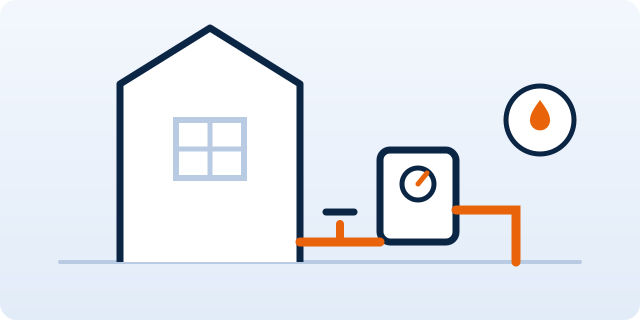
Everyone complains about weak showers, but the opposite problem — water pressure that's too high — does far more damage, and most homeowners discover it only after something fails. California plumbing code requires pressure regulation when static pressure exceeds 80 psi, yet homes on hilly terrain or near pumping stations routinely see municipal pressure well above that. A $15 gauge from any hardware store, screwed onto a hose bib, settles the question in two minutes. Here's what the number means and what fixing it costs.
Warning signs of excessive pressure
- Banging or thudding pipes when valves close — classic water hammer, amplified by high pressure.
- Faucets that spit or shriek, and repeated fixture failures — dripping faucets shortly after repair, running toilets, burst washing machine hoses (a top cause of home flooding — see washing machine hose failure).
- Water heater relief valve dripping — thermal expansion on top of already-high pressure pushes the T&P valve past its limit; often the missing piece is an expansion tank.
- Pinhole leaks in copper. Sustained high pressure and the velocity it drives are contributors to premature pipe wall failure — see copper pinhole leaks.
- A high water bill — every existing drip and leak wastes more at higher pressure; see hidden leak causes.
That last point isn't intuition — it's one of the most robust findings in water engineering. Allan Lambert's widely cited analysis for the International Water Association, "What do we know about pressure-leakage relationships in distribution systems?" (2001), synthesized field data showing leakage rates rise steeply with pressure — reduce pressure and existing leaks lose less, new leaks form more slowly, and fixtures last longer. The physics applies just as well downstream of your meter as it does in the utility's mains (study on Google Scholar).
The fix: a pressure regulator (PRV)
If your gauge reads over 80 psi — or over ~70 psi with symptoms — the fix is a pressure-reducing valve on the main line after the shutoff, set typically to 50–65 psi:
- New PRV installation: typically $350–$800 in California depending on access and whether the main needs re-plumbing to fit it.
- Replacing a failed existing PRV: $275–$650 — regulators wear out in 10–15 years, and a failed-open regulator is how a house that "always had fine pressure" suddenly develops all the symptoms above. Full breakdown in our pressure regulator replacement guide.
- Add an expansion tank if you don't have one: $250–$600. A PRV (like any check valve) creates a closed system, and California code requires somewhere for heated water to expand — skipping it just moves the stress to your water heater.
Two nuances worth knowing
- Pressure vs. flow. If your shower feels weak after a regulator install, the answer is usually adjusting the PRV setting or cleaning aerators — not removing the regulator. Persistent low-flow symptoms have their own diagnostic path in water pressure problems and low pressure in the shower only.
- Whole-street pressure varies by neighborhood. Homes at the bottom of a hill in the same zone as homes at the top routinely see 100+ psi. If you're in one, treat the PRV as scheduled maintenance, not a one-time fix.
Statewide baselines for pressure work are on our water pressure cost page.
Get local pricing
A gauge reading plus your symptoms is all a plumber needs to quote this accurately — homeowners request pressure fixes on Plumber Comparator in Anaheim, Alameda and Burbank. Take the two-minute gauge test, then request a free quote with the number.
Need a plumber you can trust?
Tell us about the job — a licensed California plumber gets back to you with a real quote.
Get free quotes