Sewer Line Root Barrier Installation: How It Works and What It Costs in California
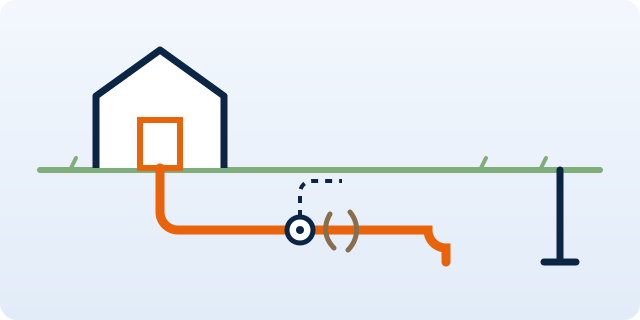
A root barrier is the option that sits between two expensive extremes. If a mature tree keeps sending roots into a California sewer lateral and the backups are becoming a pattern, the two "solve it completely" answers are removing an established tree or replacing the pipe. A root barrier is a third path: a physical wall trenched into the ground between the tree and the pipe run that redirects root growth away from the line, leaving both the tree and the existing pipe in place.
What a root barrier actually is
In residential use, a root barrier is almost always a rigid or semi-rigid panel — commonly high-density polyethylene (HDPE) sheeting or a similar geomembrane, sold in interlocking sections — installed vertically in a trench dug between the tree's root zone and the sewer lateral, typically 12 to 24 inches deep depending on the pipe's burial depth and local soil conditions. Roots growing toward the pipe hit the smooth barrier wall and are deflected sideways and downward instead of continuing straight through it. Some products use a textured or fabric surface designed to constrict rather than simply deflect regenerating root tips, slowing regrowth further. Chemical barriers (root-growth-inhibiting treatments applied to soil or trench walls) exist too, but physical panel barriers are the more common residential installation because they don't require ongoing reapplication.
How well the research says it actually works
Root barriers aren't a folk remedy — they've been studied directly. A study published in the Journal of Arboriculture tested three different barrier materials (a tough nylon fabric, a copper screen, and a commercial product called Biobarrier) against regenerating roots of established, 9-year-old trees, and found that three years after installation, root penetration through all three barrier types was substantially lower than through unprotected control sections (Wagar & Barker, Journal of Arboriculture, 1993). That's a genuinely useful data point for a homeowner deciding whether a barrier is worth installing on an already-mature tree, not just new landscaping. The honest caveat from the broader arboriculture literature on this topic: no barrier material tested has been shown to be permanently and completely root-proof, and barriers tend to perform worse in compacted or poorly-drained soil — exactly the conditions common along a trenched utility corridor. A root barrier meaningfully reduces the odds and delays the timeline of reinvasion; it doesn't guarantee the pipe is safe forever.
What it typically costs in California
Pricing has three components, and quotes vary widely because contractors bundle them differently:
- Barrier material — roughly $0.75–$5.50 per linear foot for panel or membrane stock, depending on depth, thickness and brand.
- Trenching — roughly $4–$12 per linear foot on its own, more in rocky or compacted soil, or where the trench has to work around other utilities, irrigation lines, or hardscape.
- Installed total — professionally installed root barriers commonly run in the $15–$45 per linear foot range in most cost guides, with some California metro-area quotes reaching $60–$75 per foot where urban labor rates and access difficulty are higher. For a typical single-tree or single-run residential job, that puts most projects in the $500–$3,000 range total, climbing toward the higher end for longer barrier runs, deeper trenching, or a yard with multiple trees near the same lateral.
Because no standard trade price list exists for this work, treat any of these as a starting point for comparison rather than a quote — get an itemized bid that separates material, trenching depth, and labor so you can compare contractors on the same scope.
When a barrier is the right call — and when it isn't
A root barrier makes the most sense when the pipe itself is still in reasonably sound condition (modern fused ABS or HDPE, or clay with only minor, localized intrusion at one or two joints) and the problem is really about a specific nearby tree rather than pipe-wide deterioration. In that situation, a barrier can meaningfully cut the frequency of future intrusion without the cost or disruption of a full removal-and-repipe. It's a weaker option when the lateral is old vitrified clay with multiple failing joints along its length — in that case the roots aren't the root cause, the open joints are, and a barrier at one tree won't stop intrusion from others or from the pipe's own deterioration. A camera inspection before committing to a barrier is worth the $150–$600: it shows whether you're dealing with one localized entry point a barrier can realistically block, or a pipe that needs repair or replacement regardless of what's done above ground.
Barrier installation vs. the alternatives
For an existing mature tree already close to a lateral, homeowners in older California neighborhoods generally weigh three options. Removing the tree is the most drastic and often the most expensive once stump grinding and any permit requirements (many California cities protect trees above a certain size or on the parkway strip) are factored in. Scheduled preventive hydro jetting keeps an already-intruded line clear on a schedule but doesn't stop new root growth from returning. A root barrier is the option that addresses the mechanism directly — cutting off the root's path to the pipe — while leaving the tree and the yard otherwise untouched, which is why it's often the first thing tried once a tree has been identified as the likely cause of a repeat clog.
Getting it done right
Barrier depth and placement both matter more than the brand of panel used: a barrier trenched too shallow lets roots simply grow underneath it over time, and one placed on the wrong side of the pipe protects nothing. This is a job for a plumber or arborist who can locate the lateral accurately first — not a DIY guess-and-trench project, since digging blind near an active sewer line risks damaging the very pipe you're trying to protect. Homeowners in root-prone, tree-lined neighborhoods across Sacramento, Oakland, and Pasadena dealing with a recurring root-related clog can request a free quote through Plumber Comparator — mention the tree, how often the line has backed up, and whether a camera inspection has already been done, so contractors can scope a barrier, a repair, or both from the start.
Need a plumber you can trust?
Tell us about the job — a licensed California plumber gets back to you with a real quote.
Get free quotes