Slab Leak in a Post-Tension Slab: Why the Repair Is Different (California)
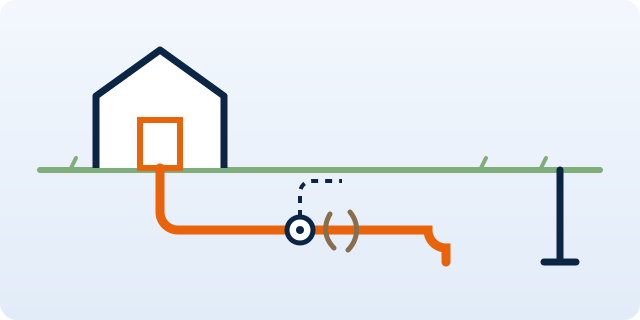
Most slab leak advice assumes one thing quietly: that a plumber can break a hole in your floor, expose the pipe, fix it, and patch the concrete. On a conventional slab, that is exactly what happens. On a post-tension slab, opening the floor is a decision with structural consequences — and a physical hazard — so the whole job changes shape before anyone picks up a tool. If you are not sure which kind of slab you own, that is the first question to settle, not the last.
What a post-tension slab actually is
A post-tensioned slab-on-ground is poured with plastic-sheathed, greased steel strands (tendons) running through it in a grid. Once the concrete cures, each tendon is pulled tight with a hydraulic jack and locked off at an anchor in the slab edge, leaving the floor permanently in compression. The Post-Tensioning Institute puts the purpose plainly: that compression resists the tension stresses shrink-swell soils would otherwise put into the foundation, letting a thinner slab outperform a conventionally reinforced one on reactive ground. That is why the method spread through California tract construction from the mid-1960s onward, especially where soils are expansive clay.
The catch is that a tendon is not passive reinforcement sitting there like rebar. A single half-inch monostrand at typical effective prestress carries roughly 25,000 to 33,000 pounds of force. Cut one and it does not simply stop working — it releases that energy, can whip or eject material at the cut, and removes real capacity from that strip of slab.
How to tell whether your own slab is post-tension
You can usually answer this yourself in about five minutes:
- Look at the garage slab. On homes built from roughly the mid-1990s on, a warning is commonly stamped into the concrete, most often under or just inside where the garage door lands: some version of "WARNING: POST-TENSION SLAB — DO NOT CUT OR DRILL."
- Look for a placard on the wall. On earlier homes the same warning was often just a plastic or paper sign near the garage door. Those get painted over, removed during remodels or lost — so the absence of a sign proves nothing.
- Walk the perimeter of the slab. Tendon anchors sit in recessed pockets at the slab edge; after stressing, the strand tails are cut and the pockets grouted. A regular rhythm of small patches around the exposed slab edge is a strong tell.
- Check your paperwork. The builder's foundation plan, the structural sheets in your city's permit file, or an old inspection report will say so outright. In a tract, neighbors on the same plan almost certainly have the same foundation.
If none of that resolves it, treat the slab as post-tension until a professional proves otherwise. The cost of assuming wrongly runs one way only.
Why nobody can jackhammer in blind
On a conventional slab, a spot repair is contained: break out a window of concrete, cut out the bad pipe, put in new, backfill and patch. Our guide to choosing between reroute, repipe and spot repair on a slab leak lays out that decision for a normal foundation.
Post-tension changes two things at once. First, the safety exposure during the cut. Second, what happens structurally afterward: tendons are typically banded in one direction and distributed in the other, so a trench through the wrong zone can take out several strands in one pass and materially reduce that strip's capacity. And if a tendon is severed, the fix is not a patch — it is detensioning, splicing in new strand, re-stressing and documenting the work under engineering supervision, commonly several thousand dollars for that one cable on top of the plumbing.
How tendons are located before any cut
The working method is ground-penetrating radar. A technician scans the target area with a high-frequency antenna and marks tendons, rebar and conduit directly on the floor, so the crew cuts into a mapped window rather than a guess. X-ray imaging exists but needs access to both faces of the slab and a cleared exclusion zone, which makes it slow and expensive inside an occupied house.
Two points to insist on. One: as-built tendon drawings from the builder do not replace a scan. Construction tolerances mean real strand positions drift from the design layout, so drawings predict and cross-check — they do not authorize a cut. Two: this is a measurement problem engineers actually study. Mazzatura, Caprili, Salvatore and Casas published a 2024 assessment of exactly this in Procedia Structural Integrity, "Accuracy of Ground Penetrating Radar (GPR) in locating post-tensioned cables" (DOI 10.1016/j.prostr.2024.09.219), on the premise that cable position must be established before anything else can be done to a post-tensioned element. If a contractor calls scanning optional, they are not describing current practice.
Why rerouting overhead usually wins
Because a slab penetration on post-tension carries scanning cost, engineering risk and a real chance of an expensive detour if something goes wrong, the default recommendation flips. Instead of opening the floor, the plumber abandons the failed line in place, caps it at both ends, and runs a new line through the attic, ceiling space or interior walls to the same fixtures. The concrete is never touched. That is common on conventional slabs too; on post-tension it is close to standard.
Rerouting a single line typically lands in the low-to-mid four figures in California, while re-plumbing the full hot and cold distribution overhead runs well into five figures on a larger home — broad ranges only, driven by fixture count, attic access, single versus two-story layout, and how much wall and ceiling comes out. Our breakdown of whole-house repipe costs in California covers the larger version of this job, and what the drywall repair and living-in-the-house phase really involves covers the part homeowners underestimate. For baselines, see our hubs on slab leak repair and repiping.
When an engineer and a permit enter the picture
If a slab penetration genuinely cannot be avoided — some drain and sewer geometries leave no overhead option, since gravity lines have to keep falling — expect paperwork. Standard practice is a structural engineer's review before any cut, defining where the opening may go and how it will be detailed. Some California jurisdictions want approved plans and the permit on site at inspection; Palo Alto's building division, for instance, publishes a dedicated post-tension slab inspection sheet. Requirements vary city to city, so ask your building department directly rather than trusting what a contractor assumes.
One more reason not to let a post-tension slab leak sit: these foundations exist because the soil underneath moves with moisture. A study by Nelson, Chao, Nelson and Overton in the Journal of Performance of Constructed Facilities (2017), "Lessons Learned from Foundation and Slab Failures on Expansive Soils" (DOI 10.1061/(ASCE)CF.1943-5509.0000958), reviewed forensic case histories of slab and footing failures and found inadequate drainage among the recurring contributing factors. A pressurized line leaking underneath is a permanent, concentrated water source in exactly the soil the slab was engineered to cope with.
What to ask before you hire
Ask four questions. Have you confirmed whether this is a post-tension slab, and how? If a cut is proposed, who is scanning, with what, and do I get the marked scan documented? Is a structural engineer reviewing it, and is a permit required in this city? What does the overhead reroute cost by comparison? Hesitation on the scanning question is disqualifying.
Before any of that, be sure you actually have a slab leak and know where it is — start with the signs and causes of a slab leak, then leak-detection methods and what they cost and our leak detection pricing hub. And read what California homeowners policies typically cover on a slab leak before you pay out of pocket.
Ready to compare licensed California plumbers who have handled post-tension foundations? Request a free quote and describe your slab type in the job details — it changes who should be bidding.
Need a plumber you can trust?
Tell us about the job — a licensed California plumber gets back to you with a real quote.
Get free quotes