Does a Dedicated Irrigation Meter Actually Lower Your Sewer Bill in California?
For the big bills · $59California Homeowner Plumbing Pack33 chapters, read online: sewer line kit · slab leak and insurance claim kit with 3 letters · month-by-month maintenance calendar · Price Book (17 jobs, 145 cities) · Water Heater Kit. What's insideOne payment of $59 · instant access, receipt by email · for California homeowners
Get the pack · $59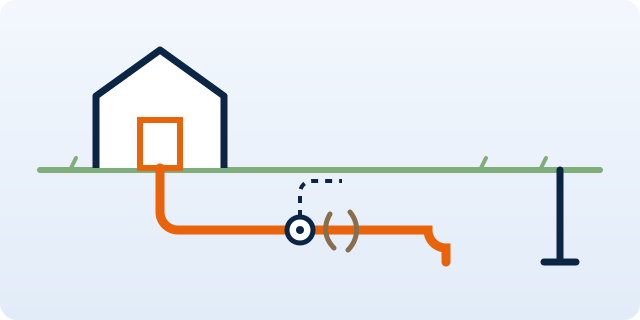
Every summer, homeowners with a large lawn, a pool that needs regular top-offs, or a few thousand square feet of drought-stubborn landscaping open their water bill and wince — and somewhere in the fine print is a sewer charge that seems to have jumped right along with the water use, even though none of that sprinkler water actually went down a drain. The fix a neighbor or a landscaper often suggests is a dedicated irrigation meter: a second meter, wired only to the sprinkler system, so the utility can see that water never touched the sewer. It's a real option in California, and it can genuinely save money — but for a large share of homeowners, their city is already solving this problem for free, and a $1,000–$10,000+ second meter would never pay for itself. Here's how to tell which situation you're actually in.
Why irrigation water gets charged for sewer service in the first place
Most California utilities bill wastewater (sewer) service as a charge tied to how much water passes through your meter, on the assumption that whatever comes in eventually goes out through the drains. That assumption holds for a shower or a washing machine. It doesn't hold for a sprinkler system, a drip line, or a pool refill — that water soaks into the lawn or evaporates and never enters the sewer system at all. With a single meter measuring both indoor and outdoor use, a homeowner who irrigates heavily in July can end up paying sewer treatment fees on thousands of gallons that a treatment plant never touched.
The free fix most California cities already give you: winter averaging
Before spending anything on a second meter, check how your city actually calculates your sewer charge — because many already correct for this. A widely used method called winter averaging sets your annual sewer charge based on your metered water use during the winter months (commonly November through April), when irrigation is off or minimal, rather than on your actual usage each billing period. The City of San Diego uses exactly this approach: each single-family account's flat sewer rate is set from the water used the previous winter, specifically so a customer isn't billed sewer fees on summer irrigation water. Santa Rosa's utilities department does the same thing under the name "sewer cap," averaging indoor water use across several winter billing periods and crediting water that never reaches the sanitary sewer. If your city bills sewer this way, a dedicated irrigation meter would not lower your bill by much, if anything — you're already only paying sewer charges on your indoor, winter-representative usage, no matter how much you water the lawn in August.
The way to check is simple: look at your water bill (or your utility's website) for language like "winter average," "sewer cap," or "wastewater based on winter usage." If it's there, call your utility and confirm your account is enrolled — new owners sometimes aren't automatically. If your bill instead shows a sewer charge that rises and falls every month with your actual metered water use, with no winter-based cap, you're in the group a dedicated meter is actually built for.
When a dedicated irrigation meter is worth pricing out
A separate irrigation meter tends to pencil out for specific situations: properties on a flat, actual-usage sewer rate with no winter averaging; large lots, pools, or extensive drought-resistant landscaping that pushes irrigation well above typical indoor use; HOA or shared-landscape accounts billed as a single large parcel; and new construction or a major remodel, where adding a second service line is far cheaper while the yard is already torn up than as a standalone retrofit later. It's also worth asking about during any large-scale project like a full repipe or a major remodel, when a plumber is already pulling permits and running new lines.
East Bay Municipal Utility District (EBMUD), serving the East Bay, is one example of a California utility that explicitly offers this as a standard application — "dual service" — for single-family and duplex customers, not just commercial accounts, which confirms it's a real, requestable option rather than a niche commercial-only product. Your own utility may call it something different (irrigation meter, landscape meter, dual service, sub-meter); the application process and eligibility rules vary by provider.
What it costs, and why the range is so wide
There's no single honest number here, and any guide that gives you one is guessing. Installing a dedicated irrigation meter typically means a new tap into the utility's main, a second meter box or vault, and the piping to route it separately from your domestic supply — plus, in most jurisdictions, a required backflow preventer on the irrigation line with annual testing, the same device and ongoing cost covered in our backflow preventer testing guide. Small jurisdictions with simple tap-and-permit processes can run a few hundred to a few thousand dollars. Large-city utilities with bigger meter sizes and infrastructure requirements can run dramatically higher — Los Angeles Department of Water and Power's published fee schedule, for instance, lists standalone landscape irrigation meter installations starting in the five figures for anything beyond the smallest residential size. The only way to know your real number is to contact your specific water utility (not a national average) for a quote, and to compare that quote against your actual potential savings — the same math covered from the connection-fee side in our water service tap fee guide.
Doing the payback math before you commit
Pull your last 12 months of bills and estimate how many gallons your irrigation typically adds above your winter (indoor-only) baseline during the growing season. Multiply that by your utility's per-unit sewer rate to estimate your current annual overcharge — that's your ceiling on possible savings, and if your city already winter-averages, this number is close to zero no matter how much you irrigate. Compare that annual figure against the installation quote plus the ongoing cost of a second meter's base service charge and backflow testing. For a heavy irrigator on a flat, non-averaged sewer rate, payback inside a few years is realistic. For a modest yard, or a city that already excludes winter-baseline irrigation, it usually isn't.
It's also worth remembering that any metering change only tells you what you're using — it doesn't reduce use on its own. A California study led by researchers at UC Davis, published in Environmental Research Letters in 2020, tracked real households that received advanced (AMI) water meters and found the households that actually realized meaningful financial savings were disproportionately ones with hidden leaks the new meter data exposed, not simply households that got a more detailed bill. The lesson carries over here: a second meter is a billing tool, not a fix by itself, and it's worth having a plumber confirm there's no irrigation-side leak inflating your usage before you pay to install one — see our irrigation and sprinkler leak repair guide if a zone seems to be running longer or more often than it should.
Getting a straight answer for your property
The honest first step costs nothing: call your water utility, ask directly whether your sewer charge is based on winter averaging or on actual metered use, and if it's the latter, ask what a dedicated irrigation meter application would cost for your address and meter size. If the math looks favorable, a licensed plumber handles the property-side piping, backflow device, and any permit coordination the installation requires. Plumber Comparator connects California homeowners with licensed local plumbers for exactly this kind of scoping work — in Sacramento, Fresno, Riverside and across the state; request a free quote to get a real assessment of whether a second meter is worth it for your yard.
Need a plumber you can trust?
Tell us about the job — a licensed California plumber gets back to you with a real quote.
Get free quotes