Finding Your Sewer Lateral Before You Dig: Route, Depth, and Why 811 Won’t Mark It
For the big bills · $59California Homeowner Plumbing Pack33 chapters, read online: sewer line kit · slab leak and insurance claim kit with 3 letters · month-by-month maintenance calendar · Price Book (17 jobs, 145 cities) · Water Heater Kit. What's insideOne payment of $59 · instant access, receipt by email · for California homeowners
Get the pack · $59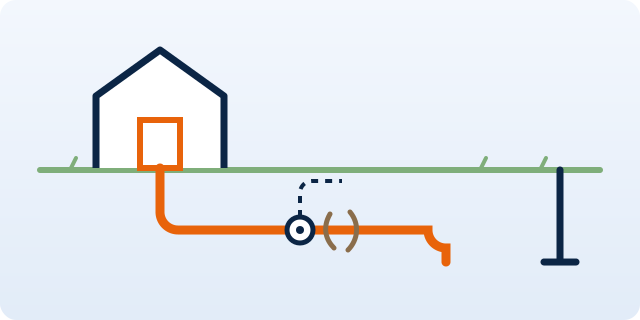
You called 811, waited the two working days, and came home to a lawn striped in red, yellow, blue and orange paint. Then you walked the yard looking for the one line your excavator actually has to miss — the sewer lateral running from your house to the main — and it isn't there. Not mismarked. Not faint. Simply absent. Homeowners planning a pool, an ADU foundation, a driveway pour, a retaining wall, a mature tree, or a trenchless repair discover this at the worst possible moment, and the usual explanation they get ("811 only does public lines") is true but incomplete. The real reason is more specific than that, and it changes how you should go about getting an answer.
California's dig law leaves gravity sewers out on purpose
There are two separate things going on, and only one of them is the "public versus private" story.
The first is ownership. California's one-call system routes your ticket to member utilities, and each marks only what it owns. USA North 811, which covers northern and central California, puts it plainly on its own site: the members notified on your ticket are responsible for marking the facilities they own and operate, and private utility lines "will not be marked since they are not owned by a utility." DigAlert, the notification center for the southern counties, gives homeowners the same instruction from the other direction — for anything on your property past the meter, contact a private locating company. That's the part most articles stop at.
The second reason is statutory, and it's the one almost nobody mentions. California Government Code section 4216 defines the thing that has to be located — a "subsurface installation" — as "any underground pipeline, conduit, duct, wire, or other structure, except nonpressurized sewerlines, nonpressurized storm drains, or other nonpressurized drain lines." A residential sewer lateral is a gravity line. So is the city main it connects to. Both sit outside the definition the locate obligation is built on. That is why you can do everything right under the dig law and still end up with zero information about the one pipe your project is most likely to hit. The rest of the 811 procedure — the two-working-day notice, white delineation of your dig area, the 28-day ticket — still applies to your excavation and is worth getting right; our guide to calling 811 before digging in California walks through it. Just don't expect it to produce a sewer mark.
The method that actually works: a camera, a sonde, and someone walking your yard
The standard answer for a private lateral is a push camera with a sonde — a small transmitter built into or behind the camera head that broadcasts a signal (512 Hz is the common frequency) outward through the soil while the camera is inside the pipe. A technician walks the surface above with a receiver, finds the peak signal, and marks that point. The receiver also computes a depth at each mark. Do that every few feet and you've converted an invisible pipe into a painted line on your lawn with numbers next to it.
The reason this method dominates is material. Traceable pipe has to conduct. Cast iron, ductile iron and steel can be energized directly and followed with a standard electromagnetic locator. But most California laterals aren't metal: ABS and PVC in anything built or repiped in the last several decades, and vitrified clay in older housing stock across the state. Neither carries a signal. Put a locator over a clay lateral with nothing in it and you get nothing back — not a weak reading, nothing. The sonde solves that by putting the transmitter inside the pipe, which is also why a lateral with no usable access point is a harder and more expensive job: no way in, no sonde, no trace.
Electromagnetic tracing, and why a crowded yard blurs the answer
Where the lateral is metallic, or where a tracer wire was installed alongside a plastic replacement, direct electromagnetic tracing is faster than a camera run. It is not automatically more accurate. A 2019 laboratory study by Siu and Lai published in the Journal of Applied Geophysics ran 260 tests across 11 configurations of neighboring cables and metallic pipes and found that coupling between closely spaced buried lines substantially distorts the electromagnetic field the locator is reading — enough that the authors argued it should be accounted for in detection standards (Siu & Lai, 2019, Journal of Applied Geophysics). Practically, that means a narrow side yard with a water service, a gas line, an irrigation main and a conduit to the garage all running within a few feet of each other is exactly the situation where a confident-looking paint line deserves the least trust — and the situation most California lots actually present.
Ground-penetrating radar is the fallback, not the default
When there's no access point at all, GPR gets proposed. It can work, but understand what you're buying. Kavi and Halabe's 2023 study in the journal Sensors states the problem directly: non-metallic pipes are non-conductive, have electromagnetic impedance similar to most soils, and are "generally transparent to radar waves" — there simply isn't much reflection to see. Their experiments found that adding a conductive overlay to a pipe before burial raised the reflected signal amplitude by up to 4.5 times, which is useful for new installations and useless for the 1962 clay line already in your yard. They also found that in clay-heavy, moisture-rich soil a 400 MHz antenna lost the depth it had in better conditions, while a lower-frequency 200 MHz antenna still reached deeper targets (Kavi & Halabe, 2023, Sensors). Much of California is exactly that clay-heavy, seasonally wet soil. If someone quotes GPR for a plastic or clay lateral, ask what they expect to see and what happens to the fee if they see nothing.
The free homework to do first
Before paying anyone, an hour of your own work often narrows the problem enough to cut the billable time:
- Find the cleanout. It marks where the lateral leaves the building and usually points the direction of the run. If you don't have one, that's worth fixing anyway — see our sewer cleanout installation cost guide, since the cleanout is also the access point a sonde locate needs.
- Find the main. Manhole covers in the street tell you where the city line runs. In many California neighborhoods it's under the street out front; in others it's in a rear easement, which puts your lateral running the opposite way from what you assumed.
- Pull the city's record. Municipalities keep some form of house-connection record. Los Angeles is a good example of what to ask for: the Bureau of Engineering documents connections on wye sheets and wye maps, and a parcel-level sewer wye report is available through the city's NavigateLA mapping site. Other California cities file the same information under different names — sewer card, as-built, house connection permit — so call public works and describe what you want rather than asking for a specific document title.
Treat all of it as a starting hypothesis, not an answer. A 2025 comparative case study by Adebiyi, Anspach and Sturgill in Transportation Research Interdisciplinary Perspectives examined how traditional utility records hold up against field-verified subsurface utility engineering, and found meaningful gaps in both completeness and positional accuracy (Adebiyi et al., 2025). A paper record drawn decades ago, before two owners repaired and rerouted sections of your line, is a hint about where to start looking.
What the deliverable should be — ask for this before the visit
This is where homeowners lose the value they paid for. A locate that lives only in the technician's head is worth nothing next month. Specify up front that you want:
- Paint on hardscape and flags in soil, at intervals along the run — not just one dot over a defect.
- A depth figure written at each mark, not a single depth for the whole line. Laterals slope; the depth at the house and the depth at the property line are different numbers, and the difference is the information your excavator needs.
- Footage tied to the video. Each surface mark should correspond to a distance on the camera's counter, so a finding on the recording maps to a spot in the yard. Our guide to reading a sewer camera inspection report covers what else that footage log should contain.
- A photo or sketch with offsets to permanent objects. Measure each mark from two fixed features — a foundation corner, a property pin, a light pole. Paint survives about one rain and one mow. A dimensioned sketch survives the whole project.
How accurate is the number, really
A depth readout is computed from signal strength, not measured with a tape. It degrades with depth, with soil conditions, and with nearby metal — including rebar in a driveway you're standing on. Treat every mark as the center of a tolerance band rather than a hairline. Two habits follow from that. First, when the project's tolerance is tight — a footing, a caisson, a pool wall — have a pothole dug by hand or with a vacuum truck at the single most critical crossing point to convert an estimate into a visual confirmation. Second, get the locate done before design is frozen, not after. Moving a proposed ADU corner three feet on paper is free; discovering the lateral under the poured footing is not.
What it costs
Standalone private utility locating is usually billed hourly, commonly in the low-to-mid hundreds per hour with a one- or two-hour minimum or a mobilization fee, which makes a short residential job an expensive way to buy an hour of work. Most California homeowners do better bundling: a plumber running a sewer camera inspection is already inside the pipe, and adding the sonde locate is incremental rather than a separate mobilization. Our sewer camera inspection cost guide covers the typical range for the inspection itself and how locating tends to be priced as an add-on. When you call, say the words "I need the line and depth marked on the surface, not just a video" — locating is frequently an optional line item that only appears if you ask.
What to do with it once you have it
The marks are the input to a handful of decisions:
- Footings and foundations. California's building code constrains trenching near footings: Section 1809.15 of the California Building Code requires that open or backfilled trenches parallel with a footing stay above a plane sloping 1 unit vertical to 2 units horizontal from a line 9 inches above the bottom edge of the footing, and no closer than 18 inches from the footing face, and it requires footings that cross under pipes to be specially designed. Your lateral's marked position and depth are what tell an engineer whether your ADU slab, pool shell or retaining wall footing clears that plane — before anyone draws it. Our ADU plumbing cost guide covers how sewer connection routing affects an ADU budget.
- Don't build over it. A lateral under a new slab, deck or driveway is a pipe you have made permanently expensive to reach. Whether you're even allowed to, and what an easement changes, is covered in our guide to building over a sewer line or easement in California.
- Planting. Species choice and setback both depend on knowing the actual route, not the assumed one — see which trees are safe to plant near sewer lines.
- Trenchless bids. Pipe bursting and lining still need launch and receiving pits, and where those pits land relative to your hardscape and landscaping is a real cost driver. A locate before bidding lets you compare quotes on the same known geometry rather than on each contractor's guess; our trenchless sewer line replacement guide explains how the method affects the dig.
Get the line marked before the excavator shows up
The cheapest version of this job is the one done during design. The most expensive is the one done after a backhoe has already answered the question. Homeowners in Los Angeles, Sacramento and San Diego can compare licensed plumbers who run a camera and a locator on the same visit. Request a free quote and say specifically that you need the lateral's route and depth marked and documented before you break ground — not just an inspection video.
Need a plumber you can trust?
Tell us about the job — a licensed California plumber gets back to you with a real quote.
Get free quotes