How Long Does a Whole-House Repipe Take in California?
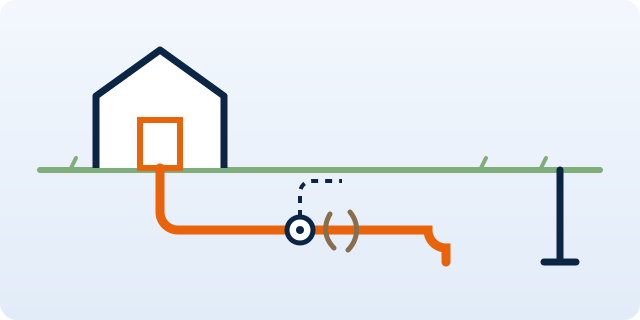
Once a homeowner decides to repipe a house instead of chasing another pinhole leak, the next question is almost always logistical: how many days does this actually take, and how much of that time is spent with no running water? The honest answer depends heavily on pipe material, home size and layout, and one California-specific step most out-of-state guides don't mention — a mandatory inspection that happens mid-project, with the walls still open.
The short version
For a typical single-story, 1-3 bathroom California home: a PEX repipe commonly takes 1-2 days, while a copper repipe commonly takes 3-5 days, sometimes longer on a large or complicated house. The gap comes down to how the two materials are joined. PEX is flexible tubing that a crew can snake through existing wall and attic cavities and connect with crimp or expansion fittings in seconds; copper is rigid pipe that has to be cut to length and soldered at every single joint, and a whole-house repipe routinely has 150-250+ of those joints. Two-story homes typically add half a day to a full day to either timeline, since the crew has to route new supply lines up through the floor system as well as across it.
What actually happens, day by day
A repipe isn't one continuous 8-hour job — it's a sequence with a hard stop built into the middle by code, which is the part homeowners are usually least prepared for.
- Day 1 — access and rough-in. The crew shuts off the main, drains the old system, and cuts small access holes in drywall (typically at each fixture and where lines run through walls or the attic) to route new pipe. This is the loud, dusty part; expect to hear cutting and see patches of open wall by evening. Water is off, or on and off intermittently, for most of this day.
- Rough-in inspection. Before any of those openings can be closed up, California code requires the new plumbing to pass a rough-in inspection — the local building department checks pipe material, sizing, and support, then the system is pressure-tested (commonly around 125 psi held for a set period) to confirm there are no leaks. On a single-story job with a same-day or next-day inspector slot, this can happen quickly; in busier jurisdictions or during peak building season it's the step most likely to add an unplanned day, since the crew legally cannot close the walls until it passes.
- Day 2 (or 3) — hookup and drywall patch. Once rough-in passes, the plumber connects the new lines to every fixture, restores full water service, and checks for leaks under real pressure at faucets, the water heater, and toilets. Drywall patches go in over the access holes — texture-matched but not painted; painting is typically the homeowner's follow-up, not part of the plumbing scope.
- Copper-specific extra time. On a copper job, add time on the front end for soldering itself, and budget for the crew to double-check every joint under pressure before Day 1 wraps, since a slow drip behind a newly closed wall is far more expensive to find later than to catch now.
What stretches the timeline beyond the typical range
A handful of things reliably push a repipe past the numbers above, and it's worth asking about each one before work starts:
- Home size and fixture count. More bathrooms, a kitchen island sink, a laundry room, and outdoor hose bibs all mean more branch lines and more connections to make and test.
- Access. A raised foundation with crawl-space access is usually faster to repipe than a slab-on-grade home, where supply lines run either through walls/attic (a full repipe reroutes around the slab) or require selective slab penetration — the latter adds real time and is a separate discussion from a standard repipe, closer to a slab leak repair.
- Inspection scheduling. This is the wildcard. A city with same-week rough-in inspection slots barely affects the schedule; a backlog of a week or more effectively pauses the project with walls open in the meantime, which is disruptive if you're living in the house.
- Older or unusual layouts. Additions, remodeled bathrooms with rerouted plumbing, or a house that mixes galvanized, copper, and old polybutylene from prior partial work all take longer to trace and replace cleanly than a straightforward original layout.
Do you actually lose water the whole time?
Not usually for the full multi-day span. Most crews restore water at the end of each working day whenever it's practical, especially if the household needs it overnight, and only shut the main off again the next morning to continue. It's worth confirming this explicitly with your plumber before the job starts — ask directly how many hours, and which specific days, you should plan to be without running water, rather than assuming the whole project is a dry-out.
Why plumbers push to finish it all in one job, not pipe-by-pipe
Some homeowners, trying to spread out the cost, ask about repiping a section at a time — the kitchen this year, the bathrooms next year. Plumbers generally advise against it, and there's real evidence behind that advice, even though it comes from a different but closely related context: municipal lead service line replacement. A peer-reviewed study by researchers at Dalhousie University, published in Environmental Science & Technology in 2016, compared full versus partial replacement of lead water lines and found that full replacement cut lead levels sharply within days, while partial replacement more than doubled short-term lead release and left a larger share of homes above the EPA action level even six months later — the disturbed, half-old/half-new system released more contamination than either leaving it alone or finishing the job completely (study on Google Scholar). Household repiping isn't the same system, but the underlying logic transfers directly: disturbing part of an aging pipe network and leaving the rest in place, sometimes for a year or more, tends to create more corrosion and connection points for problems than finishing the job in one continuous, inspected push.
Getting a realistic timeline for your house
Ask any plumber bidding the job for a written timeline broken into the same three phases above — access and rough-in, inspection, and hookup/patch — plus their honest estimate of local inspection wait times, not just their own labor days. That single question separates a bid that's realistic about California's permit process from one that's quoting labor time only. Plumber Comparator connects California homeowners with licensed local plumbers in Oakland, Bakersfield, San Diego and statewide who can walk your specific layout and give a day-by-day plan before you commit — request a free quote to get started.
Need a plumber you can trust?
Tell us about the job — a licensed California plumber gets back to you with a real quote.
Get free quotes