Why Copper Repipe Quotes Went Up in 2026 — and What That Does to the PEX Decision
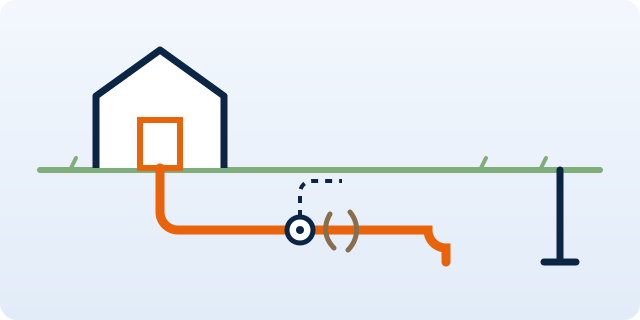
If you got a copper repipe quote in 2024, filed it away, and pulled it back out this summer, the new number probably came as a shock. That isn't your plumber padding the bid. The wholesale cost of copper tube has moved substantially — and the cost of the main alternative, PEX, has barely moved at all. That gap is the single most useful thing a California homeowner can understand before signing a repipe contract this year.
The number that matters, from a source nobody is selling you anything with
The Bureau of Labor Statistics publishes producer price indexes for materials at the level plumbing wholesalers actually buy them. Two series tell the whole story:
- Copper and brass mill shapes (the family that includes copper water tube): index 663.3 in July 2025, 785.5 in July 2026 — up 18.4% year over year. Measured from January 2025, it's up about 21.6%.
- Plastics pipe and pipe fittings (the closest published proxy for PEX): 437.7 in July 2025, 456.8 in July 2026 — up 4.4%. From January 2025, up about 1.4%.
A roughly 14-point divergence in a single year, and about 20 points over eighteen months. This is federal, free, and updated monthly, and it is a far more reliable guide to what happened than any contractor's explanation — including ours.
The distributor level corroborates it. United Pipe & Steel, a PHCP distributor that publishes dated mill price announcements, posted four separate copper tube increases between July 20 and August 6, 2026 — two multiplier increases and a 5% list price increase inside about two and a half weeks. That is what a fast-moving input cost looks like from the counter your plumber buys at.
What actually happened in the copper market
Two policy events and one commodity cycle, in order:
August 2025 — the Section 232 copper tariff. A proclamation signed July 30, 2025 imposed a 50% tariff effective August 1, 2025 on semi-finished copper products — pipes, tubes, rods, sheets, wire — and on copper-intensive derivative products including pipe fittings. Notably, refined copper cathode and raw material were left out, and the duty originally applied only to the copper content of a product. The market had priced in something much broader: when the exclusion became known, COMEX copper fell from an all-time record near $5.90 a pound to about $4.33 within days.
Through 2025 — the price ran anyway. Tariffs were never the main driver. Copper finished 2025 up roughly 42% on the year, settling at $12,423 a tonne on the LME on December 31, on data-centre and grid demand, mine supply disruption and a weak dollar.
April 2026 — the base widened. A proclamation signed April 2, 2026 and effective April 6 changed how Section 232 duties are calculated: they now apply to the full customs value of covered articles rather than only the metal content. Same headline rate, much larger taxable base — and that is the change that shows up in the 2026 half of the PPI series above. Copper's 50% rate was left untouched by the June 2026 adjustments that reshuffled steel and aluminum derivatives.
Two clarifications, because both circulate wrongly. First, the Supreme Court's February 20, 2026 decision on tariffs concerned IEEPA authority; Section 232 tariffs, including the copper one, were not affected — they rest on separate statutory authority. Second, a widely-quoted "copper pipe up 76%" figure is a 2022 number that search engines keep serving as current. It isn't.
Does a tariff on a metal really reach a homeowner's invoice?
Economists have measured this directly. A 2019 study by Amiti, Redding and Weinstein in the Journal of Economic Perspectives, examining the 2018 US tariff round, found essentially complete pass-through of tariffs into the domestic prices of imported goods, with the incidence falling on US consumers and importing firms rather than on foreign exporters (study on Google Scholar). Later work found border pass-through near-complete but retail pass-through more muted, so the honest framing is: at the wholesale counter your plumber buys from, expect the cost to arrive close to in full; at the level of a finished installed price, labor and overhead dilute it.
What this actually does to a repipe bid
Material is only part of a repipe. Labor, drywall access and patching, permits and inspection make up a large share of the installed price — which is why the installed cost of a copper repipe has not moved 18% even though the tube did. Two practical consequences:
- An old copper quote is not usable. A bid from 2024, or even from last winter, is no longer a fair reference point for negotiating. Get fresh bids rather than arguing about a stale one.
- The copper-versus-PEX gap widened. PEX repipes were already cheaper, mostly on labor — flexible tube means fewer wall openings and less patching. The material divergence pushes the two further apart than in 2024. That doesn't automatically make PEX right for your house; our copper versus PEX comparison and our guide to PEX-a, PEX-b and PEX-c cover the durability, water-quality and resale questions that should still drive the decision. Some homeowners will still choose copper, and there are legitimate reasons to.
Broad installed ranges in California remain what they were in kind — copper repipes are the more expensive path and PEX the less expensive one — but published installed prices all come from contractor marketing, so treat any specific figure you read online, including in cost guides, as an order of magnitude rather than a quote. Our repipe cost guide and the repiping cost page give ranges on that basis.
Don't let price news push you into deferring a real problem
The wrong reaction to material inflation is postponing a repipe that the plumbing itself is demanding. Pinhole leaks in copper are not a rare failure mode: a 2021 review by Gibson and Karney in AWWA Water Science, surveying thirty years of research on copper pitting corrosion, reported on the order of 750,000 pinhole leaks a year in the United States and concluded the underlying mechanisms remain poorly understood (study on Google Scholar). A house that is producing repeat pinholes — the pattern described in our guide to copper pinhole leaks — is on a schedule set by the pipe, not by the commodity market. The cost of waiting shows up as water damage, and increasingly as an insurance problem.
How to read a 2026 repipe quote
- Ask what's material and what's labor. A bidder who can separate them can explain a price increase; one who can't is guessing. Our guide to reading a plumbing estimate covers what a properly itemized bid looks like.
- Ask how long the price holds. With four supplier increases inside three weeks this summer, a 30-day validity on a material-heavy bid is reasonable, not a red flag. A quote that's silent on validity is the one to question.
- Get bids for both materials on the same scope. That's the only way to see what the divergence is worth in your specific house — the answer depends heavily on access, wall finishes and fixture count. Our guide on how many plumbing quotes to get explains why two or three is the useful number.
- Consider a partial repipe if only one run keeps failing; see partial versus whole-house repipe. Material inflation makes scope discipline worth more than it was two years ago.
If your house is due for a repipe and the numbers you're seeing don't match what you budgeted, the useful next step is fresh, comparable bids rather than more reading. Describe the house — age, pipe material, number of bathrooms, slab or raised foundation — on Plumber Comparator and request a free quote. Repiping is one of the most-quoted jobs on the site, from San Jose to Riverside.
Need a plumber you can trust?
Tell us about the job — a licensed California plumber gets back to you with a real quote.
Get free quotes