Boiler Pressure Too High or Too Low: Causes, Fixes and Repair Costs in California
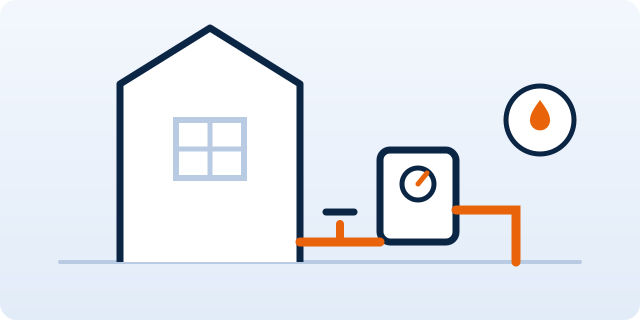
On most residential hydronic boilers, the pressure gauge should sit at roughly 12–15 psi when the system is cold, rising a few psi as it heats. When it drifts below ~10 psi the boiler may lock out or heat poorly; when it climbs toward 25–30 psi the relief valve starts dripping and something genuinely needs attention. Here's how to read what your gauge is telling you — and what each fix costs in California.
Pressure too low: usually the cheapest problem
- Normal seepage over months. Hydronic systems lose a little water through micro-leaks and air venting. Topping up via the filling loop or fill valve until the gauge reads 12–15 psi cold is a free, homeowner-level task on most boilers — your manual shows the valve.
- Pressure drops again within days or weeks? You have a real leak: a radiator valve, pipe joint, or the boiler itself. Start with our guide to a leaking boiler. Small accessible leak repairs typically run $150–$450; leaks hidden in walls or under floors cost more because finding them is most of the job.
- Boiler won't heat some radiators after repressurizing? Air is likely trapped — see bleeding and balancing radiators.
Pressure too high: three usual suspects
- Overfilling. The most common cause is simply someone topping up too far, or a filling loop left cracked open. Bleeding water out of a radiator until the gauge reads 12–15 psi costs nothing.
- Waterlogged expansion vessel. The expansion tank absorbs the water's expansion as it heats; when its air charge leaks away or the bladder fails, pressure spikes on every heating cycle and the relief valve drips. Recharging the vessel with air is a quick service task (often folded into a $150–$300 service call); replacing a failed vessel typically runs $300–$700 installed depending on size and access.
- Failed fill valve or pressure-reducing valve. If the valve feeding the boiler no longer shuts off fully, city main pressure creeps into the heating loop. Replacement is typically $200–$500.
One warning: if the relief valve discharges regularly, don't cap or plug it — that valve is the last safety on the system. Chronic dripping means fix the cause, and sometimes the valve itself afterward ($150–$350).
Why this stuff goes unnoticed for years
Hydronic heating is reliable enough that most owners never look at the gauge until something drips or stops heating. Research bears out how little attention residential heating systems get: a study by Leen Peeters and colleagues published in Energy and Buildings in 2008 surveyed how residential heating systems are actually configured and controlled in practice and found that real-world settings and maintenance routinely deviate from design assumptions, degrading both comfort and efficiency (study on Google Scholar). An annual check — gauge, expansion vessel charge, relief valve, combustion — catches pressure problems before winter; see what a boiler service costs in California.
Repair vs. replace
Pressure components are cheap relative to the boiler. But if a 20+ year old unit needs an expansion vessel and a fill valve and shows heat exchanger corrosion, weigh the repair against boiler replacement cost — and check our boiler repair cost guide for the full menu of typical fixes. Boilers heating radiant floor loops have their own failure points, covered in hydronic radiant heating repair.
Get local pricing
Boiler work is a specialty — many general plumbers don't touch hydronics, which is why searches for boiler repair spike in California's colder valleys and desert winters, from Indio to Cathedral City to Bakersfield. Describe your boiler's symptoms and gauge reading on Plumber Comparator and request a free quote from a contractor who actually works on hydronic systems.
Need a plumber you can trust?
Tell us about the job — a licensed California plumber gets back to you with a real quote.
Get free quotes