Cost to Run Water & Sewer Lines to a Detached Garage or Shed in California (2026)
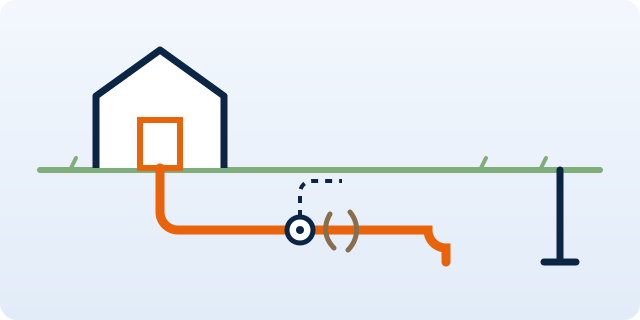
A detached garage that becomes a workshop, a she-shed that becomes an office, a barn that needs a wash-down sink — sooner or later the same question comes up: what does it cost to get real plumbing out there? Unlike an interior remodel, most of the expense in this job is not the pipe or the fixture, it is the ground between the house and the structure. Understanding that up front is what keeps a $2,000 estimate from turning into a $9,000 surprise.
What the job typically costs
For a simple cold-water hose bib or utility sink tapped off the house's existing line, a short run of 20–40 feet in open dirt typically lands at $1,000–$3,000 installed, permit included. Add hot water, a full bathroom, or a kitchenette, and the job becomes a small branch of the house's plumbing system rather than a single tap: $3,500–$9,000 is the realistic range once you account for a longer trench, a vent, and fixture installation. If the structure also needs a sewer connection — a bathroom or laundry hookup rather than just a hose bib — budget $4,000–$15,000+, because gravity sewer lines need consistent fall to the main and, on a flat lot, that often means a sewage ejector pump pit instead of a simple gravity tie-in.
Trenching is the real cost driver
Pipe and fittings are cheap; digging is not. Open trenching runs roughly $5–$15 per linear foot in easy dirt, but that number climbs fast — $15–$40+ per foot — the moment the route crosses a driveway, patio, or existing landscaping that has to be cut and restored, or when the soil is rocky, has heavy clay, or sits close to tree roots. Distance matters in a straight line: a 20-foot run and a 100-foot run are different jobs, not the same job with more pipe. On a large lot this is exactly why the same "run water to the garage" project quotes at $1,500 from one contractor and $6,000 from another — get the trench route walked and priced explicitly, not folded into a lump sum.
Permits are not a formality here
Every California city and county requires a permit for a new underground water or sewer line, even a short one, and inspectors specifically check trench depth, bedding, and — in many jurisdictions — a backflow preventer at the tap so a problem in the outbuilding's plumbing can never siphon contaminated water back into the house supply. Skipping the permit is a common shortcut on this particular job because the trench gets backfilled and the evidence disappears, but an unpermitted line surfaces at resale inspection or, worse, during a leak claim when an insurer asks for permit records. See our California plumbing permits guide for what the review process generally involves.
There is also a real safety reason not to have this dug by whoever is cheapest and fastest. A trench only a few feet deep can collapse without warning — one cubic yard of soil weighs roughly as much as a small car — and a landmark study of 306 fatal trench cave-ins investigated by OSHA, published by Suruda, Smith and Baker in the Journal of Occupational Medicine (1988), found that most of the deaths happened in shallow trenches while crews were digging sewer lines, almost always because the trench walls were not shored or sloped (study on Google Scholar). That is the exact scenario a detached-garage sewer connection creates — a homeowner or a day-labor crew digging a "quick" trench with no protective system. A licensed, insured plumbing contractor knows the depth at which Cal/OSHA requires shoring or a sloped trench and carries the equipment for it; that is worth paying for on this job specifically.
Gravity sewer vs. a pump — and why it changes the price
If the detached structure sits higher than the point where the new line meets the house's sewer, gravity does the work and the job stays on the lower end of the range. If it sits at the same grade or lower — common with a garage built at driveway level while the house sewer exits toward the street from a different side — the fix is usually a small sewage ejector pump and basin inside or near the structure, which lifts wastewater up into the gravity line. That adds real cost and a bit of ongoing maintenance, but it is a well-proven fix; our sewage ejector pump cost guide covers pricing and how the pump itself holds up over time. Worth deciding on paper before the trench is dug — moving a line uphill after the fact means redoing the work.
The well and septic wrinkle
On properties still served by a private well or a septic system — common on the half-acre-plus parcels and horse properties around cities like Jurupa Valley — adding a detached structure's plumbing means adding real demand to a system sized decades ago for the house alone. A well with a marginal pump or pressure tank can show weak flow the moment a second building draws water at the same time as the house; a septic system sized for a three-bedroom home was not designed with a workshop sink or an extra bathroom in mind. Either issue is worth a quick capacity check by a licensed contractor before, not after, the trench goes in.
Extending gas at the same time
If the detached structure is also getting a heater, a water heater, or a shop appliance, it is almost always cheaper to trench the gas line in the same excavation as the water line rather than open the ground twice. See our gas line cost guide for what that add-on typically runs — the marginal cost of a second pipe in an already-open trench is a fraction of digging it separately later.
Getting the right bid
Because trenching dominates the price and is the easiest line item to underbid or lowball, get at least two or three itemized quotes that separately price: the trench (length, depth, and any concrete or hardscape cutting), the pipe and fittings, the permit, and the fixture work inside the structure. Confirm the contractor is pulling the permit — not you — and ask directly how they plan to handle the trench depth and whether shoring applies. A straightforward hose bib run does not need much of this; a bathroom or full utility hookup does, and it is the step homeowners skip most often on this particular job. If you are ready to compare quotes for water or sewer service to a detached structure, request a free quote through Plumber Comparator and we will match you with licensed plumbers who work in your area.
Need a plumber you can trust?
Tell us about the job — a licensed California plumber gets back to you with a real quote.
Get free quotes